Blue Ridge Mountains, United States
2026-07-30 15:07:21
Primary guess
Blue Ridge Mountains, United States
Confidence
• Level: Medium
• Why:
- The landscape, characterized by rolling, densely forested, non-alpine mountain ridges, is a classic signature of the Appalachian/Blue Ridge region in the Eastern United States.
- The vegetation—a mix of deciduous hardwoods and some evergreens—strongly aligns with the temperate climate of the Appalachian chain.
- The infrastructure, specifically the standard W-beam steel guardrail, is ubiquitous throughout North American rural and mountainous highways.
- While similar terrain exists elsewhere (e.g., parts of the Carpathians or temperate East Asia), the specific aesthetic of the green, "rounded" mountain slopes combined with the foreground farm-like fields and American-style road infrastructure makes the Appalachians the most statistically likely location.
Visual evidence
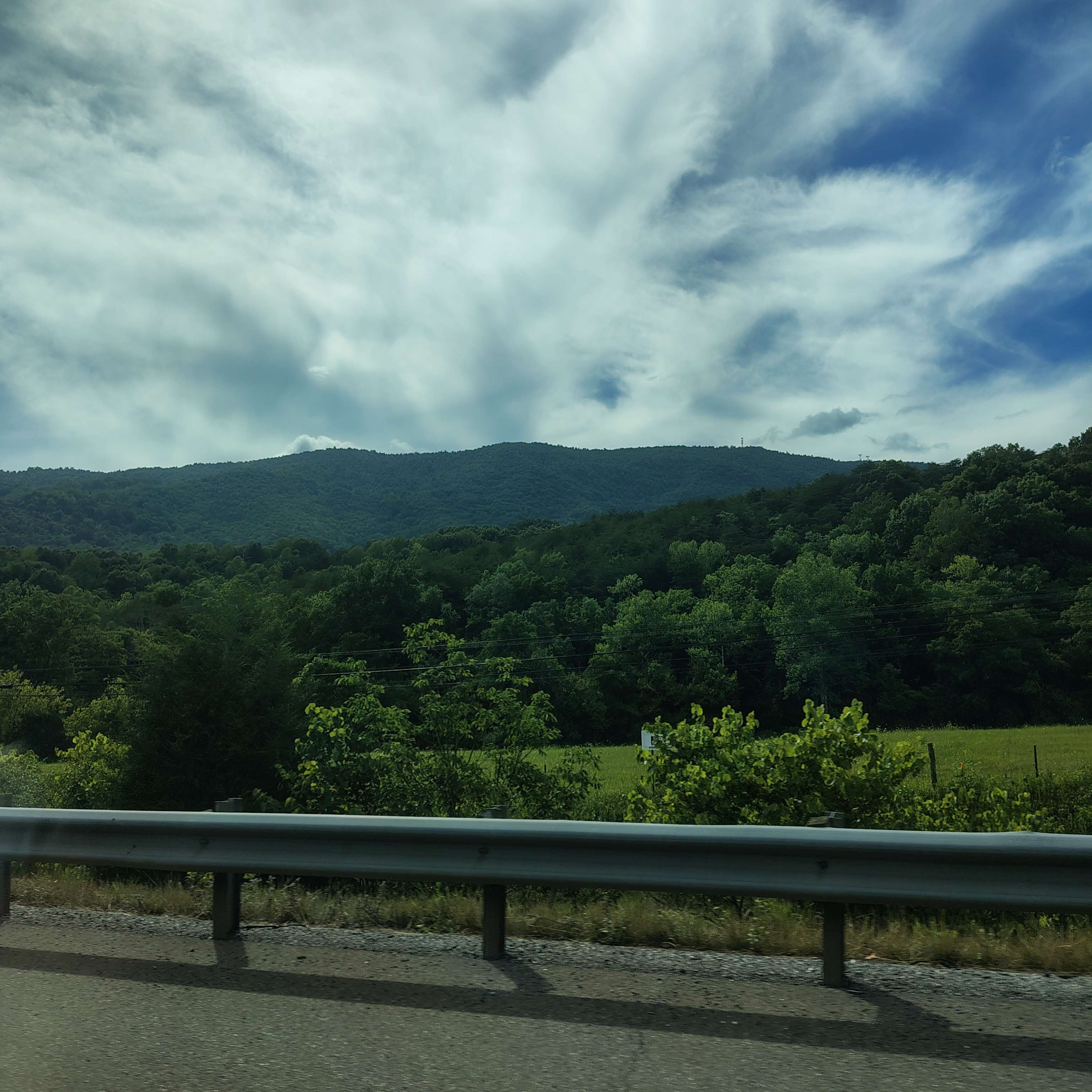
• **Mountain Morphology:** The background features "rounded" mountain ridges typical of the Appalachian Mountains, which have been weathered over millions of years compared to the jagged, sharp peaks of younger ranges like the Rockies or Alps.
• **Vegetation:** The forest is dense, lush, and green, suggesting a temperate, humid climate. The mix of deciduous trees (broad-leafed) is characteristic of the Eastern US.
• **Infrastructure:** The metal, W-beam guardrail is a standard safety feature commonly found along state and national parkways in the U.S.
• **Foreground:** The clear, maintained grassy field in the foreground suggests agricultural land use, often found in the valleys adjacent to these forested ridges.
• **Climate/Atmosphere:** The cumulus clouds and bright daylight are consistent with summer conditions in the Appalachian region.
Reasoning
The visual characteristics of this landscape are highly representative of the Eastern United States, particularly the Appalachian or Blue Ridge Mountain provinces.
* **Why it's likely the Blue Ridge/Appalachians:** The lack of snow-capped peaks or extreme, rugged terrain rules out higher-elevation ranges like the Rockies, Cascades, or Alps. The lush, vibrant green foliage and the "rolling" appearance of the mountains are distinct markers of the Appalachian chain.
* **Alternative locations (less likely):**
* **Pacific Northwest (e.g., Washington/Oregon):** While also green and mountainous, the species composition (conifers like Douglas fir) and the frequent presence of more dramatic, snow-dusted, or volcanic peaks make the Appalachians a better fit for this specific, softer horizon line.
* **Carpathians (Romania/Eastern Europe):** These look similar, but the specific type of roadside infrastructure (guardrail style and paint condition) combined with the agricultural usage patterns in the foreground slightly favors a U.S. location.
* **East Asia (e.g., South Korea):** Similar green, rolling mountains exist, but the specific texture of the forest and the open field/guardrail configuration are strongly suggestive of the North American rural aesthetic.
Verification
The combination of rounded, heavily forested ridges and standard US-style highway infrastructure is a common sight along corridors like the **Blue Ridge Parkway** or **Skyline Drive** in Virginia and North Carolina, or similar rural highways in Pennsylvania and West Virginia.
Links
• Blue Ridge Parkway (National Park Service)
• Appalachian Mountains (Wikipedia)
Coordinates
Approximate: 37.5° N, 80.5° W (Central Appalachian region). The exact location is difficult to pinpoint because these rolling, forested ridges are geographically extensive and lack unique, identifiable landmarks such as specific peaks, buildings, or unique road signs.