Brittany, France
2026-05-01 18:27:59
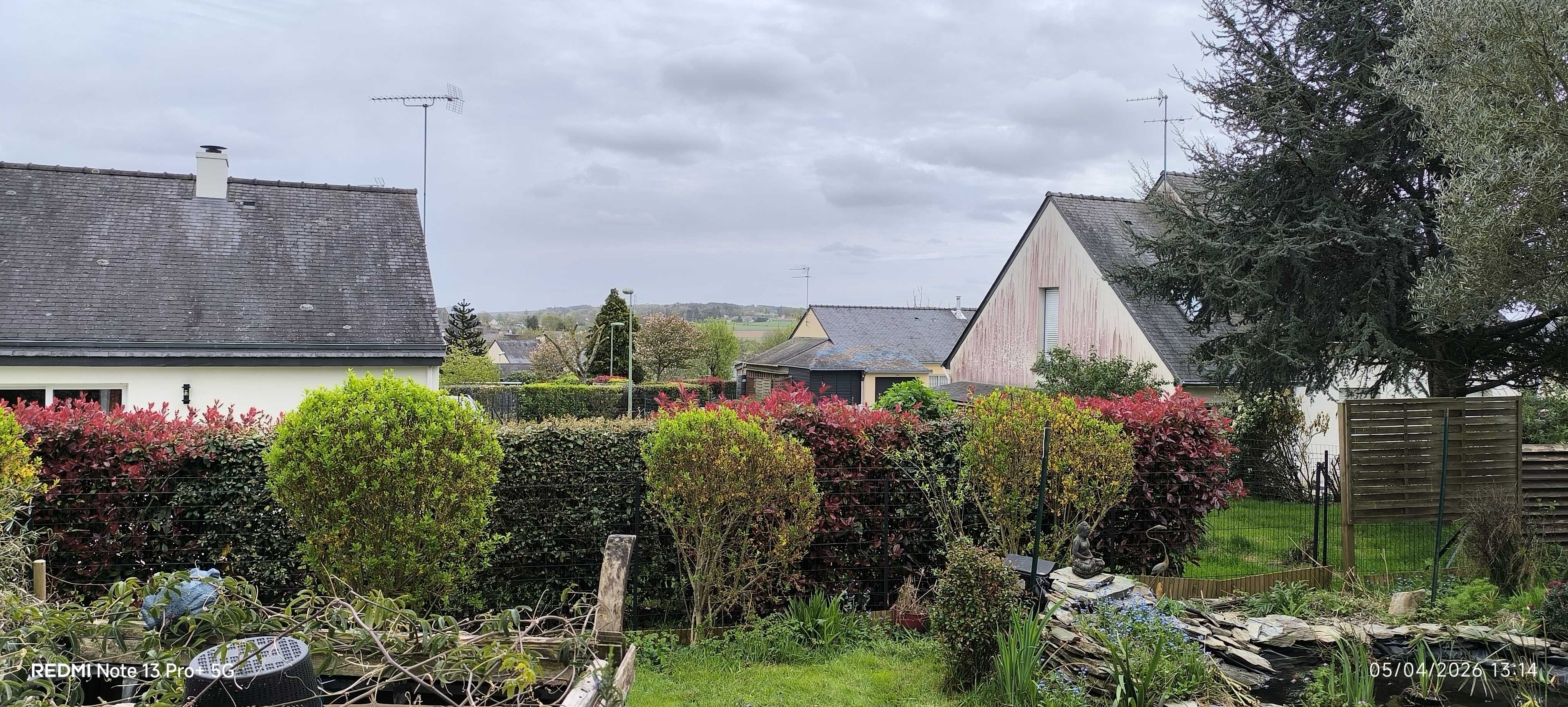
Primary guess
Primary guess: Brittany, France
Confidence
• Level: High
• Why:
- The architecture (slate roofs, white-rendered facades) is quintessentially Breton.
- The distinctive red staining on the gable of the house on the right is caused by *Trentepohlia*, a red alga that is extremely common in the humid, maritime climate of Brittany and Normandy.
- The vegetation (Photinia with red new growth, Thuja hedges, and lush green lawns) is typical of a French suburban garden in early April (matching the 05/04 date).
- The TV antennas are standard French UHF Yagi models used for "TNT" (Television Numerique Terrestre).
- The rolling "bocage" landscape in the background is characteristic of the Breton countryside (the "Argoat").
Visual evidence
• **Architecture:** Houses feature steep, dark slate roofs and white/light-colored rendered walls. This style is the standard for post-war and modern residential construction in Western France, particularly in the Brittany region.
• **Red Algae Staining:** The vertical red/pink streaks on the house on the right are a common sight in Brittany. This is an infestation of the alga *Trentepohlia*, which thrives on wet walls in mild, damp climates.
• **Vegetation:**
- **Photinia × fraseri 'Red Robin':** Visible in the foreground/midground with bright red leaves, a very popular hedging plant in France that produces this red growth in early spring (April).
- **Thuja/Leylandii Hedges:** Common privacy screening in French lotissements (housing estates).
- **Conifers:** A large mature spruce or fir tree is visible on the right.
• **Antennas:** Two TV antennas are visible on the roofs. Their design (specifically the dipole housing and reflector shape) is consistent with models sold by French manufacturers like Fracarro or Sedea for the French TNT network.
• **Climate:** Overcast, "flat" light suggesting a maritime temperate climate. The date "05/04" (April 5th) fits perfectly with the leafing state of the deciduous trees and the red growth of the Photinia.
• **Garden Features:** A DIY-style garden pond with a small "Buddha" statue and rockery, typical of European suburban garden trends. The black privacy slats in the wire fence are a common DIY product (lames d'occultation) sold in French home improvement stores like Leroy Merlin or Castorama.
Reasoning
The visual evidence strongly points to **Western France**, specifically the region of **Brittany**. The combination of slate roofs and the specific red algae staining on the walls is a "signature" of this region due to its high humidity and relatively mild winters.
The landscape in the background, with its gentle hills and mixed woodland/hedgerow (bocage) pattern, suggests an inland area of Brittany (the Argoat) rather than the rocky coast (the Armor). The houses appear to be part of a "lotissement" (a planned residential development) on the outskirts of a village or small town.
The watermark "REDMI Note 13 Pro+ 5G" indicates a phone released in late 2023, making the "2026" date likely a user-set error or a system glitch. The date "05/04" (April 5th) is consistent with the botanical state of the garden.
Alternative locations like Cornwall or Wales in the UK share similar climates and some architectural similarities (slate roofs), but the specific design of the TV antennas and the "neo-Breton" suburban house styles are distinctly French.
Verification
• **Red Algae on Walls:** Searching for "traces rouges façades Bretagne" (red traces on Brittany facades) yields numerous results describing exactly what is seen on the house on the right. It is a well-known regional issue. Example article
• **Architecture:** Searching for "Lotissement Bretagne" shows identical house styles and roof configurations.
• **Watermark:** The phone is a Xiaomi model widely sold in the French market.
Links
• Google Maps - Example of a similar suburban area in Brittany (Lannion)
• Wikipedia - Trentepohlia (The alga causing the red stains))
Coordinates
Approximate coordinates for a representative location in the Côtes-d'Armor, Brittany: **48.7300, -3.4600** (near Lannion). While the exact house cannot be pinned down without further landmarks, it is highly likely located within a 50km radius of this point.