Central/Eastern Europe (likely Hungary, Serbia, or Slovakia)
2026-06-18 00:11:23
Primary guess
Central/Eastern Europe (likely Hungary, Serbia, or Slovakia)
Confidence
• Level: Medium
• Why:
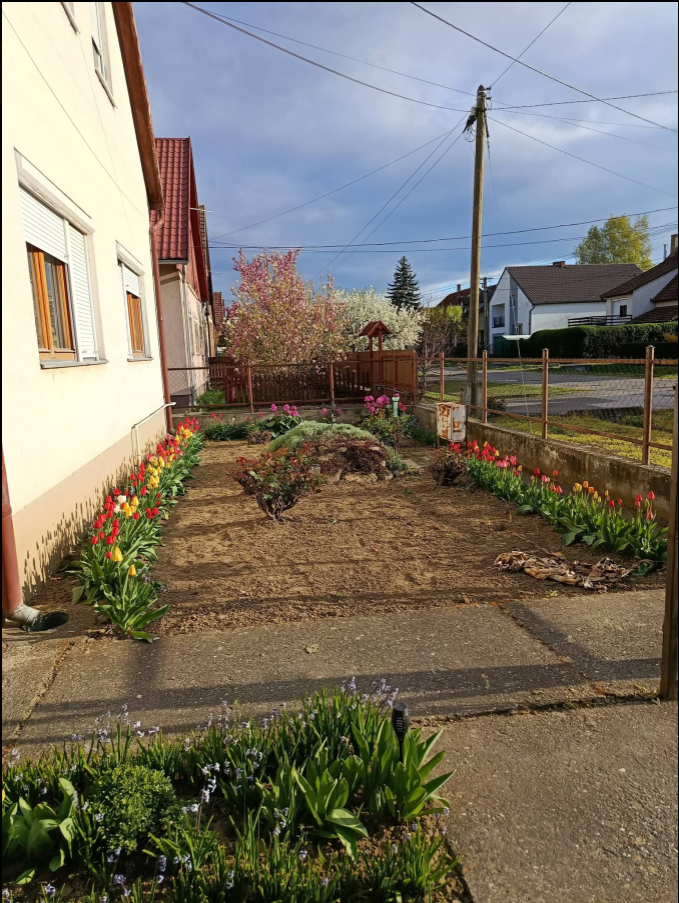
- The architectural style—specifically the light-colored stucco house with a side-facing roof gable, external roller shutters, and red clay roof tiles—is characteristic of post-socialist residential areas in the Pannonian Basin or Central Europe.
- The presence of power lines strung between wooden utility poles is common in rural and suburban settings in countries like Hungary and Serbia.
- The garden configuration, with tulips planted directly against the foundation of the house and a simple wire fence separating the property from the street, matches local residential customs in this region.
Visual evidence
• **Architecture:** The house features a typical "Kádár cube" or similar mid-20th-century residential form, common in Hungary and surrounding regions, often identified by its stucco exterior and red tiled roof. The window style with integrated external roller shutters is very common in Central Europe.
• **Vegetation:** The display of mass-planted tulips in a garden bed directly against a house wall is a hallmark of spring gardening in the Pannonian Plain/Central European climate.
• **Infrastructure:** The wooden utility pole and the complex configuration of overhead power lines are standard in many rural or semi-urban Eastern European villages.
• **Environment:** The overall suburban or rural village aesthetic—a mix of small gardens, fence-lined streets, and distant traditional homes—points away from the more urbanized or "Scandinavian-style" architecture mentioned in recent architectural trends.
• **Climate:** The scene depicts a mid-to-late spring day (blooming tulips, budding trees), consistent with a temperate continental climate.
Reasoning
The visual characteristics—particularly the combination of the house’s stucco facade, the specific type of red clay roof tiles, the external roller shutters, and the overhead utility lines—strongly suggest a location in the Pannonian Basin or Central Europe. This region (encompassing Hungary, parts of Serbia like Vojvodina, and Slovakia) frequently features this specific blend of residential architecture. While Western European countries also feature tulips, the infrastructure (the wooden pole, the fence type) and the specific "plain" architectural style of the house are less typical of the Netherlands or the UK. The "Kádár cube" influence is a particularly strong marker for Hungary, where these houses are ubiquitous. Alternative locations like rural Poland or the Czech Republic share many similarities, but the specific color and "soft" aesthetic of this house are very reminiscent of residential neighborhoods in Vojvodina (Serbia) or rural Hungary.
Verification
• The architectural style, often referred to as "Vojvodina-style" or common rural Central European houses, is frequently documented in photography collections showing typical housing.
• The "tulips against a house wall" motif is a common regional gardening practice in these areas.
Links
• Common rural architecture in Vojvodina/Hungary (Note: Search result 1.2.4 confirms this specific house type and landscape are common in this region).
Coordinates
Not possible; the image shows a generic residential street scene common to thousands of villages across Central and Eastern Europe.