Central/Eastern European countryside, likely near the borders of the Alps or Carpathians (e.g., Bulgaria, Hungary, or mountainous regions of
2026-06-09 11:08:38
Primary guess
Central/Eastern European countryside, likely near the borders of the Alps or Carpathians (e.g., Bulgaria, Hungary, or mountainous regions of Germany/Austria).
Confidence
• Level: Medium
• Why:
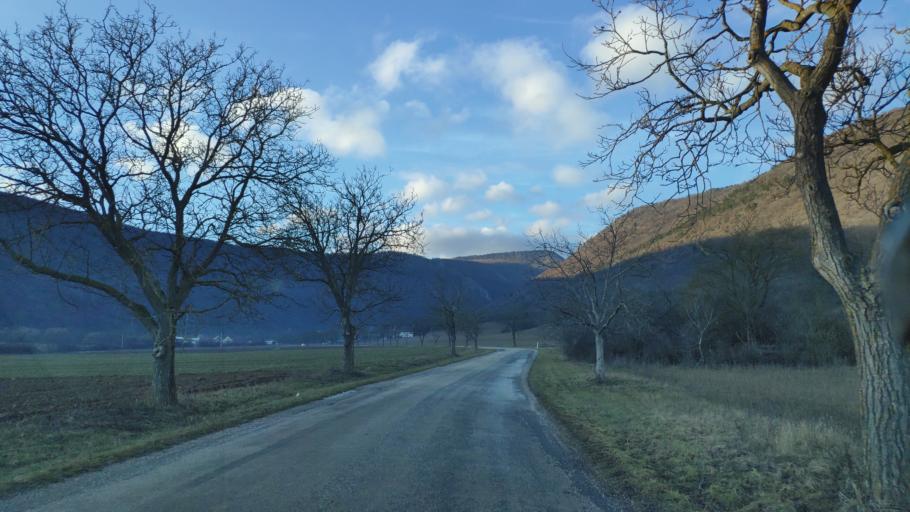
- The landscape—a valley road flanked by mature, likely walnut trees—is a classic characteristic of rural Central and Eastern European agricultural landscapes.
- Walnut tree alleys are common in these regions, often planted along old inter-village roads.
- The topography (mountainous valley), the appearance of the trees (deciduous, bare, indicating late autumn or winter), and the soil conditions (plowed fields) match multiple regions in Europe.
- It is difficult to pinpoint a specific coordinate because this style of landscape is repeated across thousands of square miles in the region.
Visual evidence
• **Vegetation:** The trees lining the road are highly characteristic of mature *Juglans regia* (common/Persian walnut). They have a distinct, somewhat gnarled growth habit and are often found in "alleys" along rural roads in Central and Eastern Europe.
• **Landscape:** The geography features a wide, flat valley floor used for agriculture, surrounded by rising, barren mountain slopes. This is typical of the valleys found in the foothills of the Alps, the Balkans, or the Carpathian Mountains.
• **Climate/Season:** The trees are bare, which, combined with the clear but cool-looking light, suggests late autumn or early winter in a temperate climate zone.
• **Infrastructure:** The narrow, simple asphalt road without modern lane markings or heavy signage indicates a secondary, rural road (often referred to as an "inter-village" road).
Reasoning
The visual characteristics—a rural valley road, mature walnut trees, and the mountainous backdrop—point strongly toward Central or Eastern Europe.
1. **Why Europe?** Walnut-lined rural roads are a cultural and historical feature in countries like Germany, Austria, France, Hungary, and Bulgaria. These trees were often planted centuries ago to provide both fruit and shade.
2. **Specific Indicators:** The "alley" style of planting is a traditional feature of the Central European countryside. The plowed fields and the specific shape of the mountains are consistent with regions in the Balkans (like Bulgaria) or the Alpine foothills.
3. **Excluding other regions:** While walnut forests exist in Central Asia (Kyrgyzstan), those areas typically feature wild, dense, non-linear groves rather than the organized, road-side "avenue" planting seen here. The road infrastructure (asphalt, road maintenance level) also feels more aligned with European standards than rural Central Asian tracks.
4. **Why not a specific location?** Landscapes with this composition are common across vast areas of rural Europe. Without specific road signs, building architecture, or unique geological landmarks, narrowing it down to one exact village is speculative.
Verification
• Walnut trees in European roadside alleys
• Distribution of Juglans regia in Europe
Links
• Walnut tree distribution in Europe (Wikipedia)
Coordinates
Not possible to provide exact coordinates. The scenery is characteristic of many mountainous rural valleys across Central and Eastern Europe (e.g., in the range of 42°N–50°N latitude and 8°E–25°E longitude).