Central/Northern Europe (specifically Germany, Poland, or similar regions)
2026-06-16 20:44:35
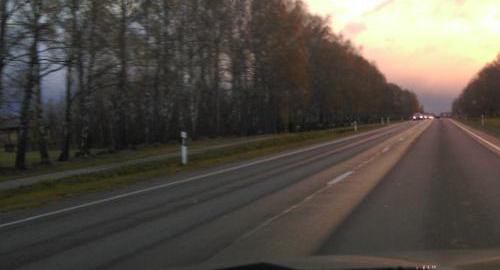
Primary guess
Central/Northern Europe (specifically Germany, Poland, or similar regions)
Confidence
• Level: Medium
• Why:
- The white delineator posts with a thin horizontal black/dark stripe are a classic design found extensively across Central and Northern Europe.
- The landscape—flat, agricultural, or rural with rows of birch or similar deciduous trees—is characteristic of the North European Plain.
- While the exact road cannot be pinpointed without unique local signs, the combination of road geometry, vegetation, and safety furniture strongly points to this region.
Visual evidence
• **Delineator Posts:** The white, reflective roadside posts (delineators) are highly characteristic of European road safety infrastructure, particularly in Germany, Poland, and neighboring countries.
• **Vegetation:** The row of mature, light-barked trees (resembling silver birch, *Betula pendula*) lining the road is a common feature in rural landscapes throughout Central and Northern Europe.
• **Road Markings:** The white dashed center line is standard for many European nations, and the lack of a prominent paved shoulder is common on rural secondary or regional roads in this area.
• **Atmosphere:** The low-angle lighting and the specific type of roadside flora suggest a temperate climate zone consistent with Germany, Poland, or the Baltic states.
Reasoning
The combination of specific roadside furniture and landscape features narrows the search to Central/Northern Europe.
1. **Delineator Posts:** The white, vertical posts are known as *Leitpfosten* in German-speaking regions. They are standard across Germany, Austria, Poland, and parts of the Czech Republic. The presence of a small, thin black stripe (or reflector) near the top is a definitive marker of this system.
2. **Tree-Lined Roads:** Such avenues of trees are a well-documented feature of rural landscapes in the North European Plain. They are often found in Germany, Poland, and the Baltic states where historical road planning frequently integrated tree lines for aesthetic, shade, and windbreak purposes.
3. **Exclusions:** Countries like France often use different types of roadside markers (sometimes reflective studs or different post designs). While some Northern European countries use similar posts, the overall aesthetic, combined with the tree types, points strongly toward the German/Polish corridor. Without specific road signs (like town entry signs or route numbers), a precise coordinate match is not possible, as this road design is uniform across thousands of kilometers of rural landscape.
Verification
• Global Bollard Identification Guide - Provides context on European delineator styles.
• German road Begrenzung marker posts - Discusses the standardization of these posts.
Links
• Google Maps (Central Europe)
• Road vegetation in Central Europe (ResearchGate)
Coordinates
Not possible to provide exact coordinates as this road type is pervasive across thousands of kilometers in Northern and Central Europe.