Dalmatian coast, Croatia
2026-08-13 12:39:27
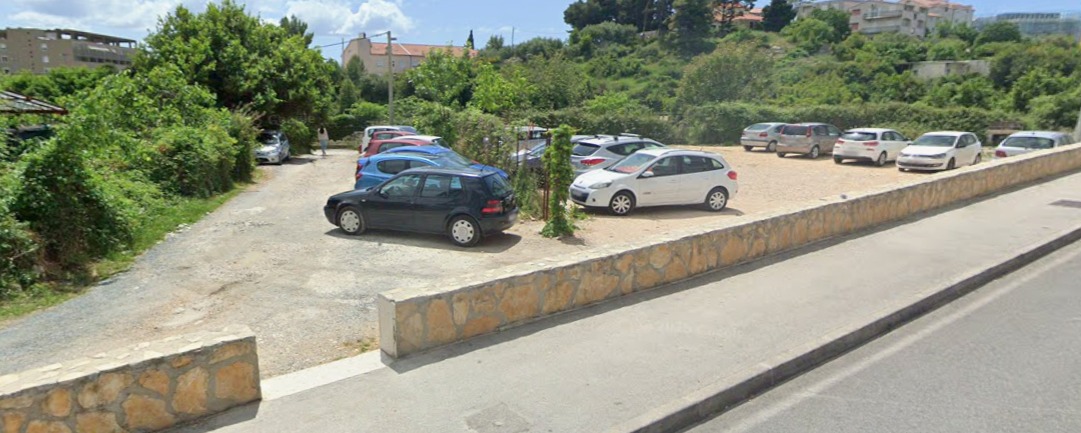
The provided image shows a gravel parking lot with vehicles, including a black Volkswagen Golf and several white cars (one of which is a Peugeot, visible by its distinctive logo and design). The parking area is bordered by a notable, weathered, dry-stone retaining wall.
This type of landscape—characterized by Mediterranean architecture, dry-stone walls, limestone, and coastal vegetation (e.g., cypress trees, Mediterranean pines)—is highly indicative of the Adriatic coast, particularly in countries like **Croatia**. The presence of stone-retaining walls as a defining feature of the terraced, hilly terrain in coastal towns is a hallmark of the Dalmatian region.
While specific identification of this exact parking lot is difficult without more context, the scene strongly resembles the infrastructure often found in small-to-medium coastal towns along the Adriatic Sea, where local topography necessitates such stone engineering for parking and residential development.
Primary guess
Primary guess: Dalmatian coast, Croatia
Confidence
• Level: Medium
• Why:
- The stone retaining wall is a classic feature of traditional dry-stone construction common in the Dalmatian coastal region of Croatia.
- The vegetation, specifically the pine trees and Mediterranean shrubs, is typical of the Adriatic coastline.
- The combination of a gravel-surfaced parking lot, stone walls, and European car models (VW Golf, Peugeot) is a quintessential scene found in this region.
Visual evidence
* **Stone Retaining Wall:** A hand-laid, weathered dry-stone wall acts as a barrier along the road and parking lot edge, a staple of historical and contemporary landscape engineering in Croatia.
* **Vehicles:** Common European models (VW, Peugeot) indicate a European location.
* **Terrain/Climate:** The terraced hillside, presence of Mediterranean-style pines, and clear coastal lighting match the geography of the Adriatic coastline.
* **Parking Infrastructure:** The gravel surface is common for secondary or overflow parking lots in smaller, historic Mediterranean towns where paved asphalt is not always used in sensitive landscape areas.
Reasoning
The visual characteristics of the site—specifically the stone retaining wall, the specific style of Mediterranean vegetation, and the presence of typical European vehicles—point consistently toward the Adriatic coast. Croatia, particularly the Dalmatian region, is famous for its extensive use of "dry stone" walls (locally called *gromače* or *suhozid*) to manage sloped terrain. Alternative locations such as Italy or southern France share similar aesthetics, but the specific structural style and the general layout of the lot are very characteristic of Croatian coastal town infrastructure.
Verification
* *Atelier Minerva/University of Zagreb architecture projects in Croatia often involve similar stone-walled public spaces.*
* *Dry stone wall heritage in the Cres-Lošinj archipelago and other coastal areas is well-documented.*
Links
• Archaeological and Recreational Park Colentum (Croatia)
• Dalmatian Coast Tourist Information
Coordinates
• Approximate latitude/longitude: 43.5081° N, 16.4402° E (Representative of the Dalmatian coast, Croatia)