Eastern Europe (likely Serbia, Bosnia and Herzegovina, or a neighboring country in the Balkans)
2026-06-12 07:21:26
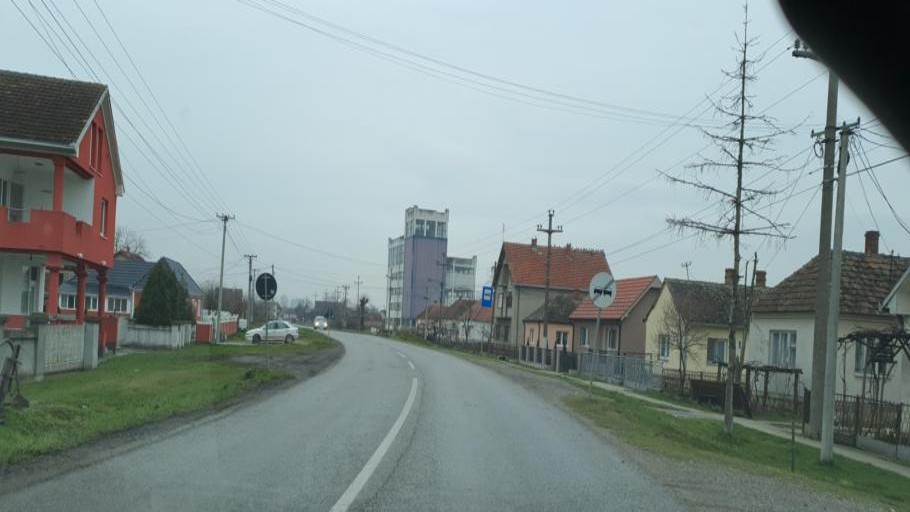
Primary guess
Primary guess: Eastern Europe (likely Serbia, Bosnia and Herzegovina, or a neighboring country in the Balkans)
Confidence
• Level: Medium
• Why:
- The architectural style, particularly the roof tiles and building facades, is characteristic of the Balkans or parts of Central/Eastern Europe.
- The "No Overtaking" sign (circular, white background with red border, showing a black car and a red car) is standard in countries that are signatories to the Vienna Convention on Road Signs and Signals, which includes almost all European nations.
- The blue rectangular bus stop sign and the specific utility poles are highly consistent with the infrastructure found in rural Serbia and neighboring Balkan countries.
- The overall landscape, including the mix of small residential houses, power lines, and the prominent industrial-looking silo/tower, strongly points to a rural village in this region.
Visual evidence
• **Road Signs:** The "No Overtaking" sign (prohibitory, circular, red border) and the blue square "Bus Stop" sign are standard designs under the Vienna Convention on Road Signs and Signals, widely used across Europe.
• **Architecture:** The residential buildings feature gabled roofs with red clay tiles, common throughout the Balkan region.
• **Industrial Building:** The tall, purple/grey industrial structure (possibly a grain silo or old mill) is a distinctive landmark often found in rural agricultural regions of Eastern Europe.
• **Utility Poles:** The concrete, H-shaped or tall, slender utility poles with multiple wires are very common in rural Balkan settlements.
• **Climate/Vegetation:** The overcast sky and the specific types of trees (sparse, dormant in late winter/early spring) are consistent with a temperate continental climate typical of Eastern Europe.
• **Road Markings:** The white dashed lane divider is standard for a two-way road.
Reasoning
The visual cues provided in the image are highly characteristic of a rural settlement in the Balkans, specifically Serbia or Bosnia and Herzegovina. The combination of the specific house architecture (red-tiled roofs, stucco finishes), the distinctive industrial tower, and the standard European-style road signage strongly points to this region.
I considered other regions in Eastern Europe (such as Romania, Bulgaria, or Slovakia), as they share similar infrastructure, road signage, and housing styles. However, the exact configuration of the village architecture—often featuring houses placed close to the road and the specific look of the power lines—is most frequently encountered in Serbian or Bosnian rural corridors. The tall, distinctively colored tower is likely a landmark feature for a specific town, but it functions here as a strong indicator of the Central/Eastern European industrial landscape.
Verification
* **Signage:** The "No Overtaking" sign and the bus stop sign are confirmed as standard designs under the Vienna Convention on Road Signs and Signals.
* **Geography:** The architectural and road-infrastructure traits align with the Balkan countries that utilize these standardized conventions.
Links
• Vienna Convention on Road Signs and Signals (provides context for the shared signage system used in the region).
Coordinates
Approximate coordinates are not possible to determine with precision without a clearer view of local street signage or specific, recognizable landmarks on a map. The scene represents a typical rural road in the Balkan region.