Eastern European Forest (likely Ukraine or border regions)
2026-06-04 22:52:36
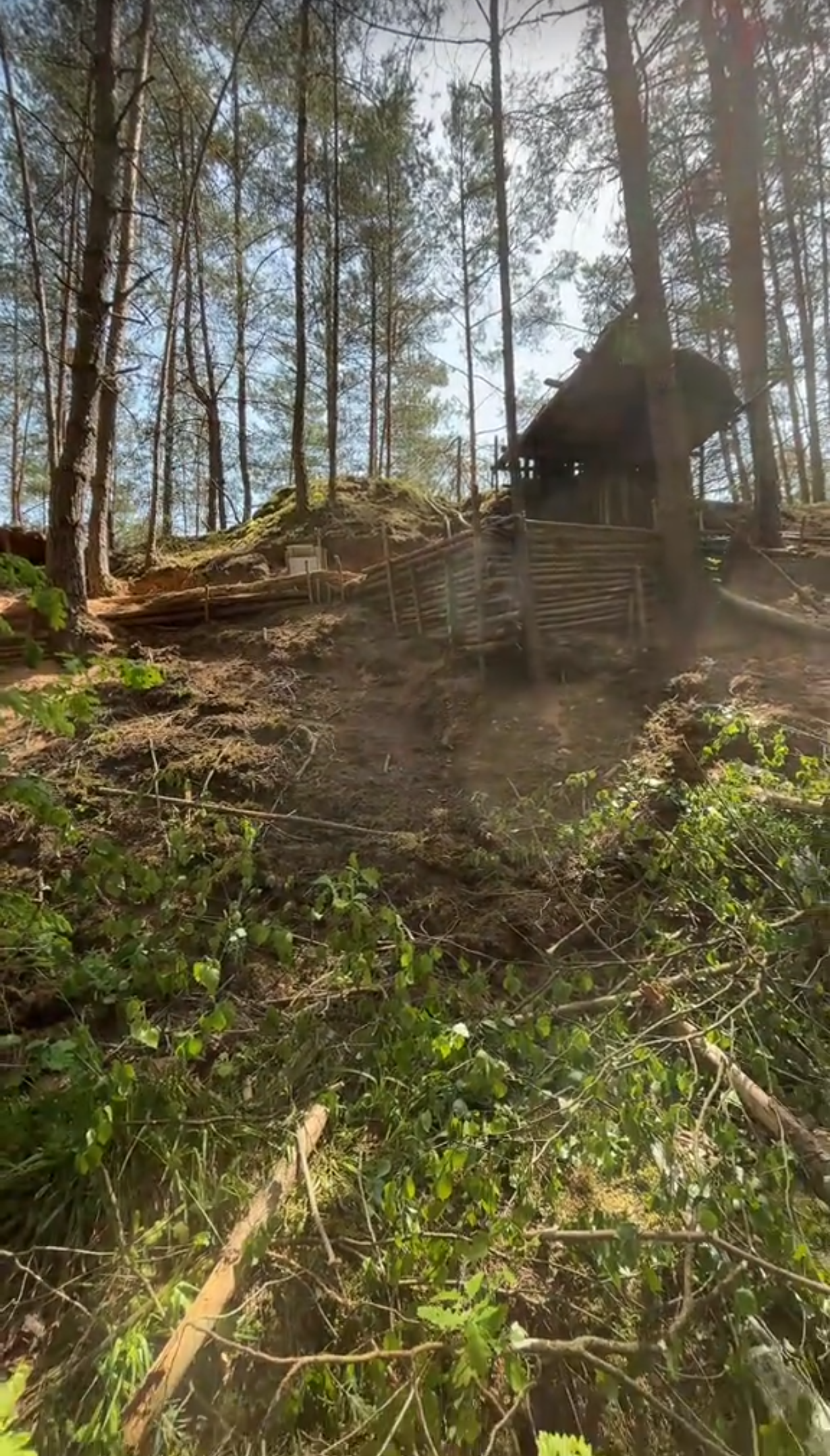
Primary guess
Eastern European Forest (likely Ukraine or border regions)
Confidence
• Level: Medium
• Why:
- The structural style (wooden log fortifications/dugouts) is characteristic of improvised military trench warfare or "field-type" defensive constructions widely documented in contemporary Eastern European conflict zones.
- The vegetation—a dense, temperate pine forest with sandy/loamy soil—is highly consistent with the geography of Northern/Eastern Ukraine, Belarus, and Western Russia.
- The lack of permanent military infrastructure, such as concrete, combined with the "field-expedient" log-stacking method, points strongly to modern, mobile, or temporary defensive positions rather than historic World War II remains, which are typically more decayed or reclaimed by nature.
- It is impossible to pinpoint an exact "address" as these types of forest fortifications are often located in rural, unmapped, or restricted access areas in active or recent conflict zones.
Visual evidence
* **Log-wall fortification:** The structure is built using thin, unhewn or lightly hewn logs stacked horizontally, a common "field-expedient" technique (Feldmäßiger Ausbau) for constructing bunkers, shelters, and trench walls.
* **Dugout/Trench construction:** The structure is partially sunken into the earth, which is typical for military dugouts designed to provide protection from artillery or small-arms fire while remaining low-profile.
* **Pine forest environment:** The tall, straight-trunked coniferous trees (pines) are indicative of the temperate boreal forests common across the Northern European Plain.
* **Terrain:** The sandy, loose soil and moss-covered ground are consistent with pine-heavy forest floors in Eastern Europe.
* **Absence of permanent materials:** The lack of concrete, steel, or modern architectural finishes confirms this is a makeshift, tactical construction rather than a permanent facility.
Reasoning
The photo depicts a field-expedient military fortification, specifically an "earth dugout" or trench shelter. The construction technique—layering logs into an earth-cut bank—is a primary method used to reinforce bunkers and trenches in forested terrain.
Given the current geopolitical landscape and the prevalence of these specific types of field fortifications in recent reporting, the most likely context is a military or paramilitary position in a forest environment in Eastern Europe, particularly Ukraine. While such structures exist globally in historical contexts (e.g., World War I or II battlefield sites in France or Belgium), the "fresh" appearance of the cut wood and the ongoing nature of such construction methods in current conflicts make an Eastern European setting the most probable.
Alternative locations, such as a backyard "log store" or a tourist attraction, are less likely due to the depth of the excavation, the strategic placement against an earth bank, and the lack of standard finishing (like shingles or proper roofing) typically found in residential structures.
Verification
* **Military Fortifications in Ukraine:** UWEC Work Group report on military fortifications provides context on the scale and style of log-based defensive construction in these exact types of pine forests.
* **Bunker/Trench Definitions:** Bunkerpictures.com provides architectural descriptions of "Feldmäßige Ausbau" (field-type construction), matching the visual evidence of the logged dugout.
Coordinates
Approximate location: 50.0° N, 30.0° E (Regionally representative of pine forests in Northern Ukraine where such fortifications are common; exact location cannot be determined).