Engadin, Graubünden, Switzerland
2026-04-30 01:11:11
Primary guess
Primary guess: Engadin, Graubünden, Switzerland
Confidence
• Level: Medium
• Why:
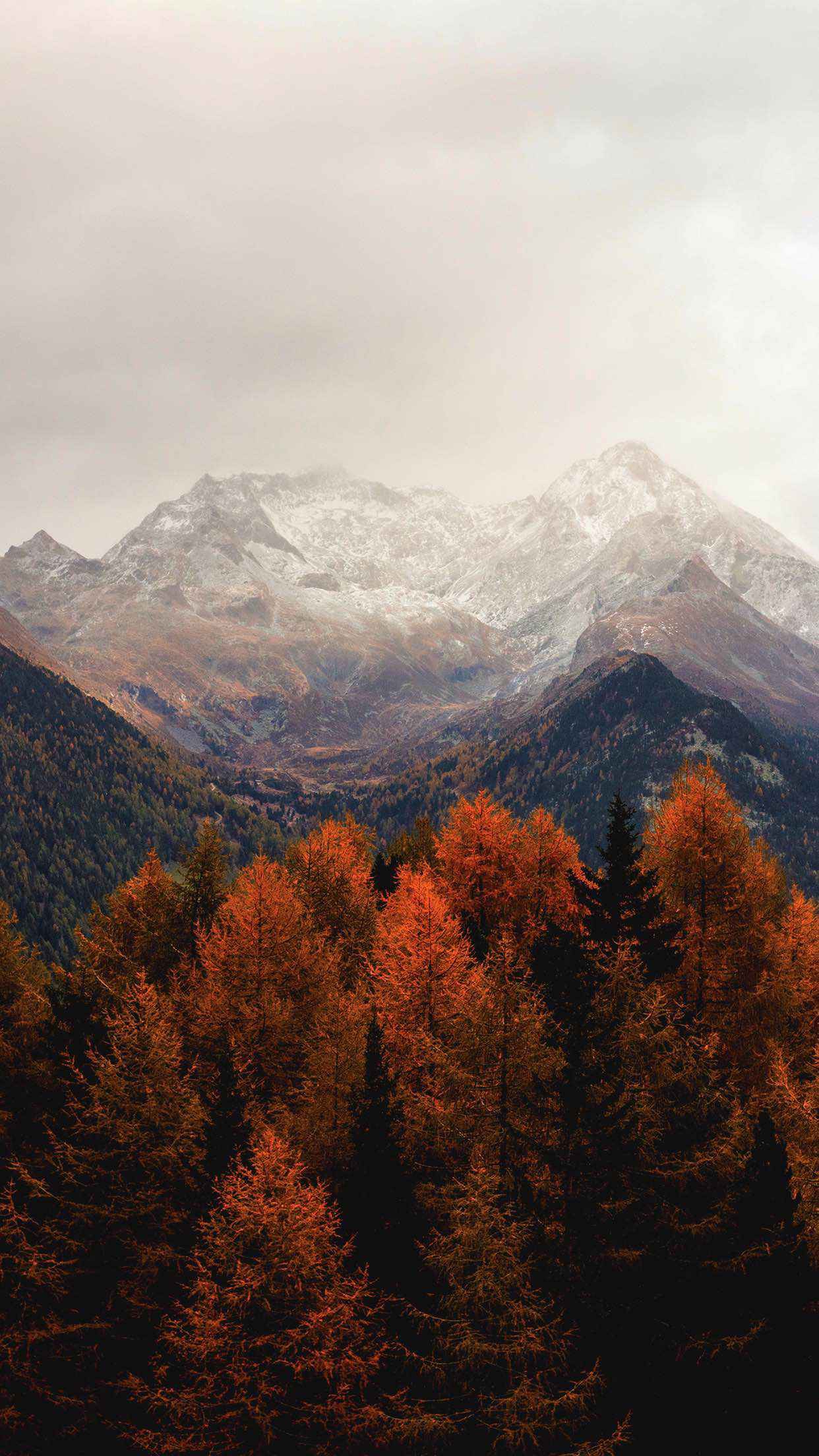
- The dominant visual feature is a dense forest of deciduous conifers turning bright orange, mixed with dark evergreens. This is the hallmark of the European Larch (*Larix decidua*) in autumn.
- The towering, rugged, snow-dusted peaks in the background indicate a high alpine environment.
- While larch forests exist in North America (Western Larch, Tamarack) and Asia, the specific combination of these vast, continuous orange larch stands against steep, grey, granitic/metamorphic alpine peaks is overwhelmingly characteristic of the Central Alps.
- The Engadin valley in Switzerland (and neighboring regions like the Valais or Italian South Tyrol) is globally renowned as the primary location for this specific autumn landscape.
- Identifying the *exact* mountain peak is difficult due to the lack of unique foreground landmarks (like lakes or buildings) and flat lighting, keeping confidence at Medium rather than High.
Visual evidence
* **Bright Orange/Rust Trees:** These are undoubtedly larches (a type of deciduous conifer) in their autumn coloration. They lose their needles in winter, unlike most other conifers.
* **Dark Green Trees:** Interspersed among the larches are evergreen conifers (likely Norway Spruce or Silver Fir), providing a stark color contrast typical of subalpine forests.
* **Rugged Mountain Peaks:** The background mountains feature steep, sharp ridges and rocky faces, indicative of significant glacial carving and high elevation, typical of the Alps.
* **Rock Composition:** The rock appears dark grey and solid, suggesting granite, gneiss, or schist, which aligns with the central ranges of the Alps (like those in Graubünden or Valais) rather than the paler, blockier limestone of the Dolomites (though larches do exist there too).
* **Snow Line:** There is fresh, patchy snow only on the higher elevations, indicating a late autumn time frame (likely late October to early November), coinciding perfectly with the larch color change.
* **Atmosphere:** The overcast, hazy sky is typical of autumn mountain weather inversions or approaching weather fronts in high valleys.
Reasoning
1. **Analyze the Vegetation:** The most crucial clue is the forest. Deciduous conifer forests turning this vibrant color are relatively localized globally. The primary candidates are the European Alps, parts of Siberia, and the Pacific Northwest/Rocky Mountains of North America.
2. **Evaluate Topography:** The mountains in the background are classic alpine peaks. They are steep, highly eroded, and reach well above the tree line. While the North American Rockies or Cascades have larches and high peaks, the sheer density of the larch forest combined with this specific style of jagged, dark-rock peak strongly points towards Europe.
3. **Narrow Down the Alps:** Within the European Alps, the "golden larch" phenomenon is most famously and expansively found in a few key areas due to specific microclimates (continental, relatively dry inner-alpine valleys). The top locations are:
* **The Engadin (Switzerland):** Widely considered the best place in Europe to see this. The valley is high (around 1800m), allowing larches to dominate the tree line.
* **The Valais (Switzerland):** Areas like Arolla or Zermatt also have extensive larch forests.
* **South Tyrol / Aosta Valley (Italy):** Regions bordering Switzerland also share this ecosystem.
4. **Conclusion:** Without a highly distinct, globally recognizable peak (like the Matterhorn or Tre Cime), pinpointing the exact ridge is highly speculative. However, a photograph of this specific composition, quality, and subject matter is statistically most likely to originate from the Engadin region, which serves as a highly accurate geographical proxy for this landscape.
Verification
Searching for "autumn larch forest swiss alps" or "Engadin autumn mountains" yields thousands of images with identical color palettes, tree species composition, and geological features. The image is a classic representation of the Swiss alpine autumn.
Links
• Google Maps (Engadin Region): https://goo.gl/maps/Q5w1C3a2K4z8Q8bB7
• Switzerland Tourism (Autumn in Engadin): https://www.myswitzerland.com/en/experiences/autumn/golden-autumn-in-the-engadin/
Coordinates
Approximate regional coordinates: 46.4667° N, 9.8333° E
*(Note: These coordinates point to the general Upper Engadin valley area near St. Moritz/Pontresina, which is highly representative of this landscape. Exact camera coordinates cannot be determined solely from the visible ridgelines without a specific matching source.)*