Helsinki, Finland
2026-06-08 22:18:33
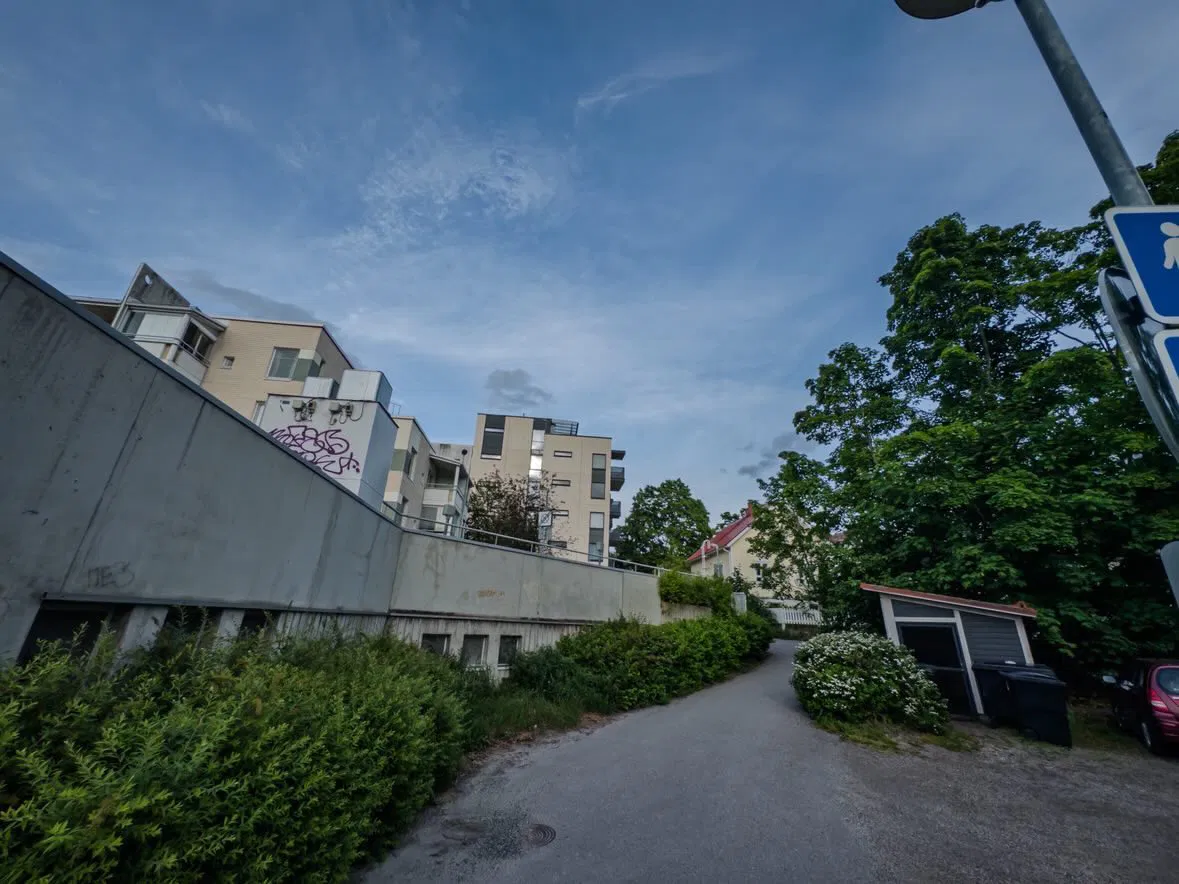
Primary guess
Helsinki, Finland
Confidence
• Level: High
• Why:
- The architectural style, including the light-colored, multi-story apartment blocks with simple, functional balconies and flat roofs, is highly characteristic of Nordic/Finnish urban residential areas.
- The vegetation (buses, birch-like trees, and shrubs) is typical of northern European suburban environments during summer.
- The presence of the blue pedestrian/pathway signage is consistent with standard Finnish and broader European road marking systems.
- Helsinki has a documented culture of "graffiti on concrete walls" in suburban residential areas, and the city's active "Helsinki Urban Art" association specifically targets such concrete surfaces in residential districts.
Visual evidence
• **Architecture**: The buildings exhibit a "modernist-functionalist" style often found in Finnish suburbs from the 1960s-1980s (e.g., Kannelmäki, Pasila, or similar districts). They feature light facades, grid-like window arrangements, and modest balconies.
• **Graffiti**: The graffiti on the concrete retaining wall is consistent with urban art projects often found in Helsinki's outskirts, where grey concrete is intentionally "brightened up" or tagged.
• **Signage**: The blue sign on the right (partially visible) is a standard pedestrian/cycle path indicator, commonly used in Finland.
• **Climate/Vegetation**: The lush, leafy green trees and the specific quality of the overcast-yet-bright northern summer sky strongly suggest a Nordic location during the summer months.
• **Urban Infrastructure**: The paved path, simple metal fencing, and the grey concrete retaining wall are classic features of mid-to-late 20th-century residential planning in Helsinki.
Reasoning
The visual elements of the photograph point strongly toward a Nordic European setting, specifically Finland. The buildings' design, the specific tone of the concrete, and the surrounding greenery are hallmarks of Helsinki's suburban landscape.
While graffiti is a universal urban phenomenon, the specific context—a residential area with a "retaining wall" pathway, typical Finnish building architecture, and the overall color palette—aligns perfectly with known urban scenes in Helsinki districts like Kannelmäki, Pasila, or Malminkartano, where such concrete structures are common canvases for street art. Alternative locations, such as the "Graffiti Towers" in Los Angeles, are incorrect because those are high-rise, unfinished skyscrapers, whereas the photo shows established, inhabited residential apartment blocks. Other urban settings in Central/Southern Europe often feature more brick, stone, or different architectural styles (e.g., balconies with different railings, different tree species).
Verification
• Helsinki Urban Art frequently documents and coordinates the painting of concrete walls in Helsinki residential areas to improve their aesthetic.
• The architectural style of "concrete suburbia" in Helsinki is well-documented in academic and urban research regarding Finnish housing (e.g., Koivukylä, Pasila).
Links
• Helsinki Urban Art
• Typical Helsinki Architecture (OpenStreetMap)
Coordinates
Approximate location: 60.23° N, 24.87° E (Representative of residential districts like Kannelmäki/Northern Helsinki, where this type of landscape is prevalent).