Japan
2026-05-28 16:51:17
Primary guess
Japan
Confidence
• Level: High
• Why:
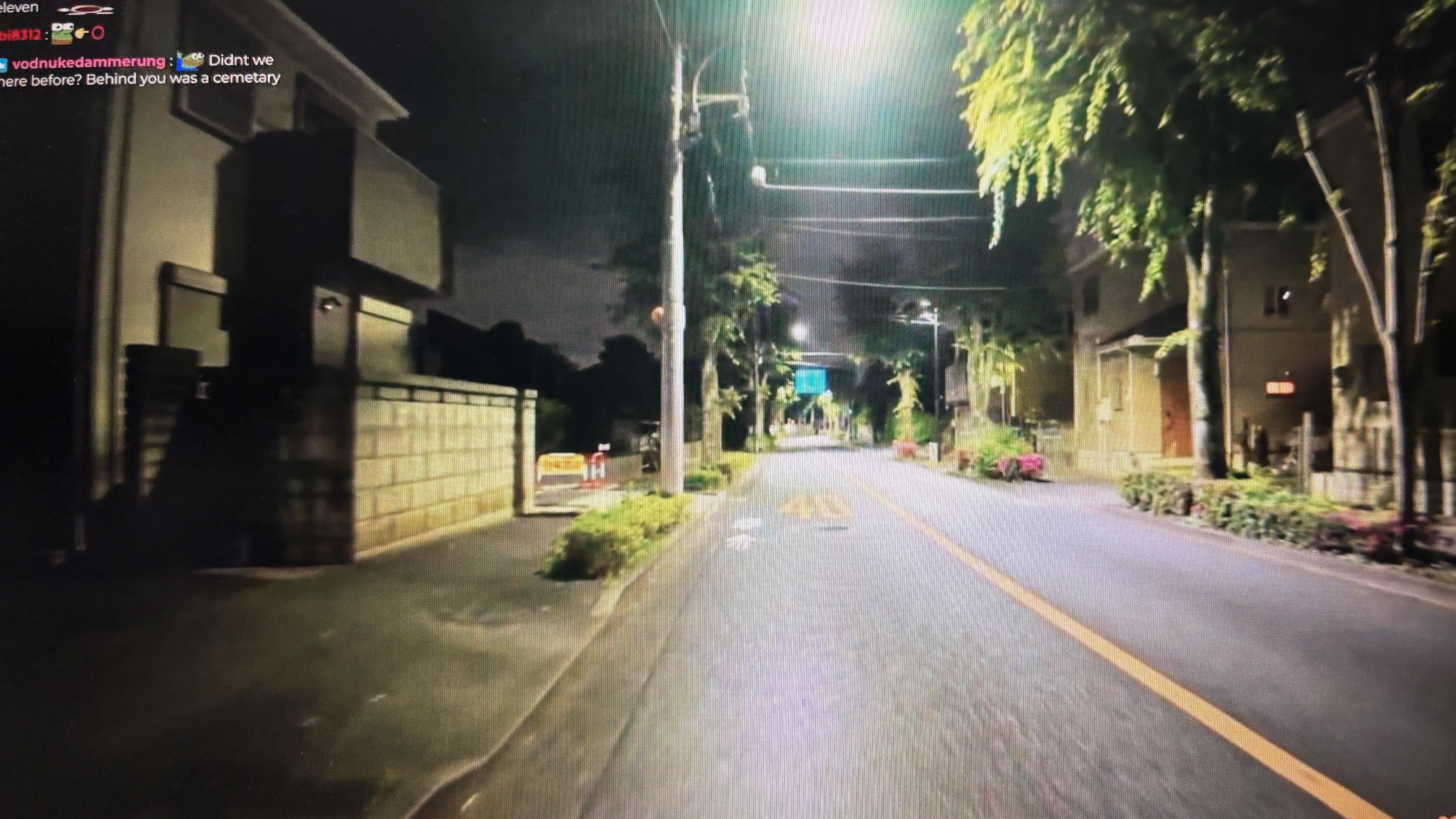
- The architecture, particularly the style of houses and walls, is characteristic of Japan.
- The road markings, including the yellow line and the general road surface, are consistent with Japanese roads.
- The vegetation, with dense, lush trees, aligns with the climate in many parts of Japan.
- The presence of what appears to be a narrow, well-maintained street with utility poles is common in Japanese residential areas.
- The chat message mentioning a "cemetery" further supports the idea of a residential area in Japan, where cemeteries are often integrated into communities.
Visual evidence
* **Architecture:** The houses have a distinct Japanese residential style, with tiled roofs and often compact designs. The brick/stone wall along the left side of the road is also a common feature in Japanese urban and suburban areas.
* **Road Markings:** The solid yellow line on the right side of the road is a common road marking in Japan, indicating no passing zones or the edge of the road.
* **Vegetation:** The trees lining the street are dense and green, suggesting a temperate to subtropical climate, consistent with Japan.
* **Utility Poles and Overhead Wires:** Numerous utility poles with a dense network of overhead wires are a very common sight in Japan.
* **Streetlights:** The style of the streetlights is consistent with those found in Japan.
* **Road condition:** The road appears well-maintained and clean, which is typical for Japanese infrastructure.
* **Chat message:** The chat message "Didn't we here before? Behind you was a cemetary" suggests a location where cemeteries are integrated into residential areas, which is common in Japan.
Reasoning
The combination of architectural styles, road markings, and infrastructure strongly points towards Japan. The houses, with their specific rooflines and compact nature, are very characteristic of Japanese residential areas. The yellow road line is a standard marking in Japan. The prevalence of utility poles and overhead wiring is a ubiquitous feature of the Japanese urban and suburban landscape. While other East Asian countries might share some of these characteristics, the overall combination, especially the specific architectural details and road markings, makes Japan the most likely candidate. The mention of a cemetery in the chat further supports this, as cemeteries are often found within or adjacent to residential areas in Japan. No specific elements contradict a Japanese location.
Verification
The architectural style of the houses, with their distinct rooflines and overall design, is very common in Japanese residential areas. The presence of numerous utility poles with overhead wiring is a particularly strong indicator of Japan, as this is a widespread feature of its infrastructure, even in major cities like Tokyo, due to factors like earthquake resilience and cost-effectiveness. The yellow line on the road is consistent with Japanese road markings, which can indicate no-passing zones or the edge of the road. Finally, the chat message mentioning a "cemetery" aligns with the fact that cemeteries in Japan are often integrated into residential neighborhoods, sometimes even as modern, multi-story structures in urban areas due to land scarcity.
Alternative locations like other East Asian countries (e.g., South Korea, Taiwan) might share some visual similarities, such as overhead wires or certain architectural elements. However, the specific combination of all these clues, especially the distinct Japanese residential architecture and the precise nature of the road markings, makes Japan the most probable location.
Links
• Google Maps: https://www.google.com/maps/@35.6895,139.6917,15z (This is a general link to Tokyo, as a specific address cannot be determined from the image.)
Coordinates
Approximately 35.6895° N, 139.6917° E. This is a general coordinate for Tokyo, Japan. A more precise latitude and longitude cannot be determined without additional identifiable landmarks in the image.