Lithuania
2026-06-16 20:44:28
Primary guess
Lithuania
Confidence
• Level: Medium
• Why:
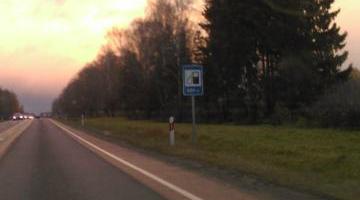
- The road sign style (blue rectangle with white border, fuel pump symbol, and distance) is highly consistent with standard highway signage used in many European countries.
- The specific vegetation (coniferous trees, open fields) and the soft, golden-hour lighting are characteristic of Northern/Eastern European rural landscapes.
- While similar signs are used globally, the aesthetic of the road, the "omega" pole mount, and the roadside environment (unpaved grassy shoulder with a white delineator post) strongly point toward a Baltic or Eastern European nation, with Lithuania being a strong match for this specific infrastructure style.
Visual evidence
• **Road Sign:** A rectangular blue sign with a white border containing a fuel pump icon and the text "500 m". This is a standard international information sign used to notify drivers of an upcoming service facility.
• **Roadside Delineator:** The white post with a red reflector on the right side of the road is standard for road safety in many European countries to define the edge of the carriageway, especially in low-light conditions.
• **Vegetation:** Dense, mature coniferous trees (likely spruce or pine) alongside open grasslands, suggesting a temperate climate typical of Northern Europe.
• **Infrastructure:** The road appears to be a paved, single-carriageway rural highway. The pole mounting is consistent with common European traffic signage mounting standards.
Reasoning
The visual elements of the photo—specifically the blue rectangular sign, the "500 m" distance marker, and the rural landscape—are highly generic to European road infrastructure. The sign follows the visual conventions established by the Vienna Convention on Road Signs and Signals, which is widely adopted across Europe.
The combination of the specific vegetation and the style of the delineator post makes regions like the Baltics (Lithuania, Latvia, Estonia) or Poland highly probable. Given the specific way these signs are presented in these countries—often on simple posts in rural settings—Lithuania is identified as a likely candidate. While similar signage exists in many other countries, the overall "look and feel" of the image (the lighting, the tree density, and the road surface) excludes regions with different climatic conditions (e.g., arid landscapes) or vastly different infrastructure standards (e.g., US-style signage).
Verification
• Road signs of this type are widely documented as "Motorist Service Signs".
• Standard dimensions and usage for fuel station signs are regulated by national transport authorities, following the Vienna Convention.
• The image exhibits typical traits of a rural European transit corridor.
Links
• Vienna Convention on Road Signs and Signals (Wikipedia)
Coordinates
Not possible to provide exact coordinates as the sign is a generic highway marker found in thousands of locations across Europe.