Mojave Desert, California, United States
2026-06-08 04:12:16
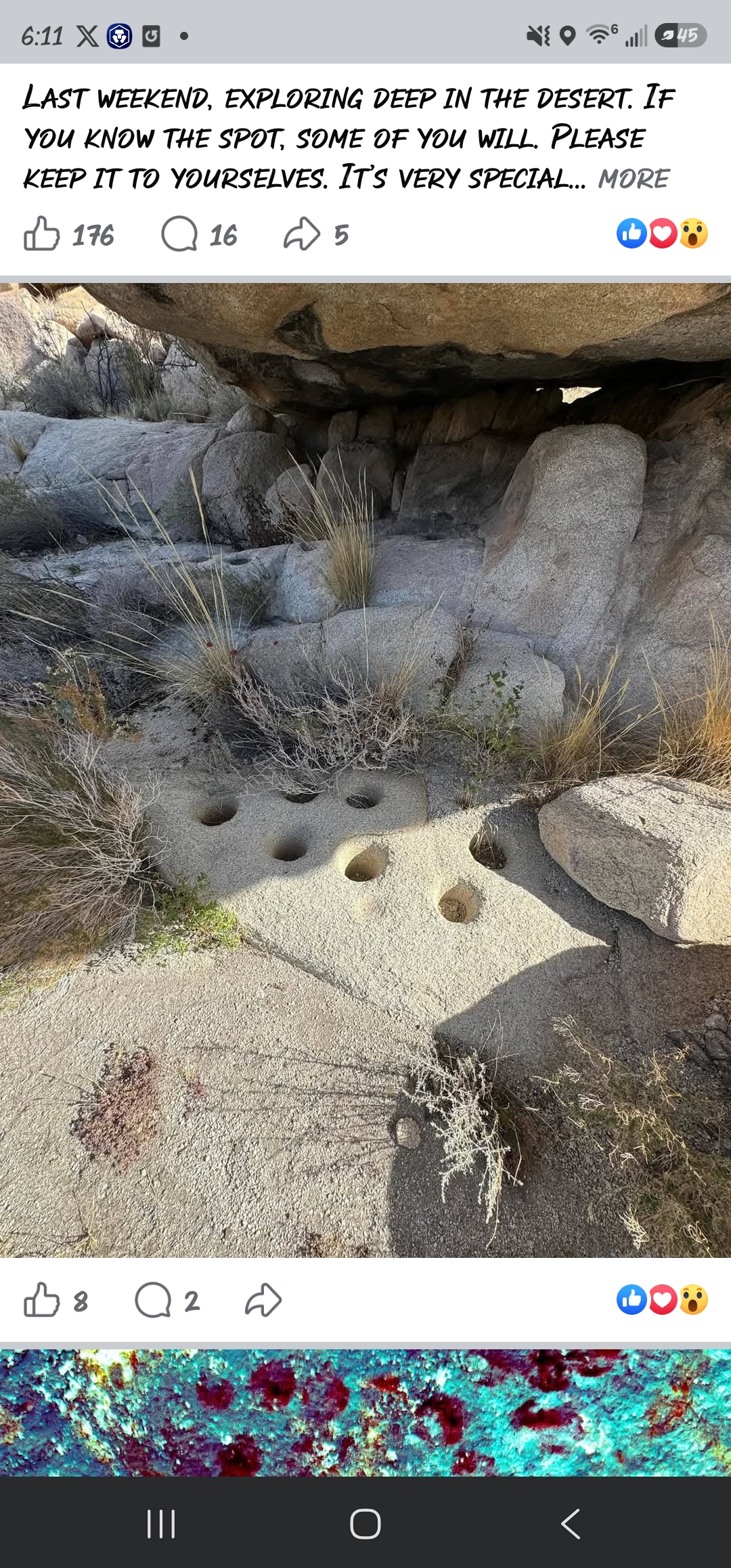
Primary guess
Mojave Desert, California, United States
Confidence
• Level: Medium
• Why:
- The image displays characteristic **bedrock mortars** (BRMs) used by indigenous peoples of the American Southwest and California to process food like acorns or seeds.
- The geological formation—large, light-colored, weathered granite boulders—is highly consistent with landscapes across the Mojave Desert, Joshua Tree National Park, and surrounding areas.
- The climate cues (dry desert brush, scrub grasses, and intense, bright sunlight) align with high-desert regions.
- Because these sites are sensitive and culturally protected, the exact location is intentionally kept private by local communities and hikers to prevent vandalism and site degradation.
Visual evidence
• **Bedrock Mortars:** The circular depressions in the stone are classic anthropogenic grinding holes used by indigenous populations. They are clearly man-made, showing the smooth, cylindrical wear patterns typical of long-term use.
• **Granite Outcropping:** The massive, rounded boulder above the mortars is characteristic of granitic desert landscapes, which are prone to exfoliation and weathering.
• **Vegetation:** The presence of dry, hardy desert scrub and bunchgrass growing directly in and around the rocks suggests an arid, high-desert environment.
• **Lighting/Shadows:** The high-contrast, harsh shadows indicate a direct, intense sun, typical of an open desert landscape with little canopy cover.
• **No Urban Infrastructure:** The lack of man-made structures, trails, or signage in the immediate proximity supports the description of the location as "deep in the desert" and "very special."
Reasoning
The site in the photo is a **bedrock mortar (BRM) site**, commonly found in the desert regions of the Western United States. These holes were created by indigenous women over generations of grinding seeds, nuts, or acorns. Similar sites are found throughout California and the American Southwest, from the Sierra Nevada foothills to the Mojave Desert and Southern Arizona.
The combination of the specific rock type (weathered granite) and the dry, sparse vegetation strongly points to the **Mojave Desert** or a similar high-desert environment in California. While similar sites exist in other regions (e.g., Texas or the Kentucky plateau), the visual character of these boulders is most iconic of the California desert regions.
Alternative locations like **Indian Grinding Rock State Historic Park** or public sites in **Big Bend National Park** are well-documented and often have more visible trail access. The user's specific request to "keep it to yourselves" is common behavior for visitors who find undocumented or "off-the-beaten-path" archaeological sites, aiming to protect them from the damage that often occurs at more publicized locations. Therefore, while identifying the *region* (Mojave Desert) is straightforward based on geology and geography, identifying the *exact* boulder is likely impossible and counter to the intent of the original poster.
Verification
• Bedrock mortar (Wikipedia)
• NPS: Potholes vs. Anthropogenic Mortar Holes
• Cultural Protection of Archaeological Sites
Coordinates
Approximate region: 34.5° N, 115.5° W (The Mojave Desert covers a vast area; specific archaeological sites are protected and not typically listed in open-source mapping to prevent vandalism.)