Rural countryside, United Kingdom
2026-06-05 03:35:05
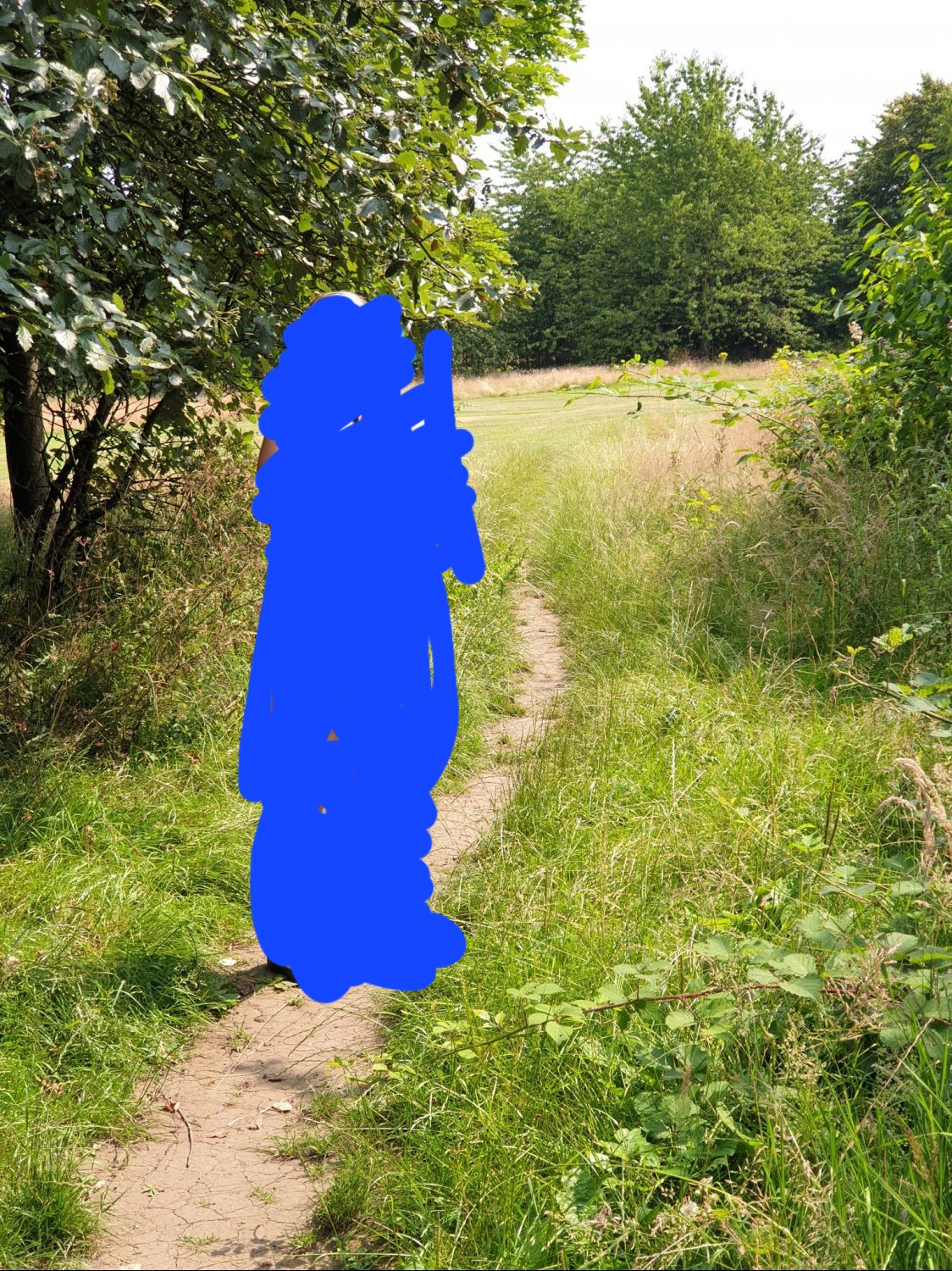
Primary guess
Rural countryside, United Kingdom
Confidence
• Level: Medium
• Why:
- The landscape features (narrow, natural dirt path flanked by tall, unmanaged meadow grass and dense, broadleaf tree lines) are characteristic of rural footpaths in the UK.
- The specific combination of deciduous woodland edge and managed/semi-wild grassland is highly typical of British "Rights of Way" or public footpaths.
- While similar landscapes exist in parts of Northern Europe, the "feel" of the path—a worn, earthy track cutting through lush green vegetation—is extremely consistent with common imagery of the British countryside.
- There are no specific architectural or cultural markers (like distinctive fencing, signage, or utility poles) that allow for a precise pinpointing of the exact location beyond identifying the general regional aesthetic.
Visual evidence
• **Vegetation:** The presence of dense, mature broadleaf trees, combined with long, unmanaged meadow grasses and brambles, is indicative of a temperate maritime climate common in the UK and Western Europe.
• **Path structure:** The narrow, dirt-trodden path indicates a frequently used pedestrian trail, often found in rural areas where "Rights of Way" legislation provides public access.
• **Climate/Lighting:** The dappled, bright sunlight and vibrant green foliage suggest a mid-summer setting, consistent with the temperate, often humid, growing seasons of the British Isles.
• **Terrain:** The flat or gently rolling nature of the ground is consistent with much of the lowland rural landscape found across Southern, Central, and Eastern England.
Reasoning
The photo depicts a generic, albeit beautiful, rural footpath. To determine the location, one must look at the ecology and the nature of the path itself. The vegetation, primarily broadleaf deciduous trees and lush grasses, suggests a temperate climate with reliable rainfall. This aesthetic is deeply characteristic of the United Kingdom, where such footpaths are protected and abundant.
While this environment could arguably exist in parts of the Netherlands, Northern France, or Germany, the combination of a natural, worn dirt path (without heavy graveling or engineered drainage) and the specific density of the hedgerows/woodland edge is most iconic to the British countryside. Other locations, such as Scandinavia or Southern Europe, would likely feature different tree species (more conifers in the north) or dryer, sparser vegetation (in the south). Given that there are no unique signs, buildings, or specialized flora visible, the most accurate categorization remains a generic rural area in the United Kingdom.
Verification
• National Landscapes (formerly AONB) in the UK - These areas often feature exactly this type of managed yet "natural" walking terrain.
• Rights of Way and Public Access in the UK - The Ramblers provide extensive documentation on the vast network of footpaths that define the British rural walking experience.
Links
• National Landscapes Association
• The Ramblers (Walking Charity)
Coordinates
Not possible to provide. The image features a generic natural landscape with no unique landmarks, buildings, or identifiable signs that would allow for precise geolocation.