Rural road along the Volga River, Russia
2026-06-06 14:50:26
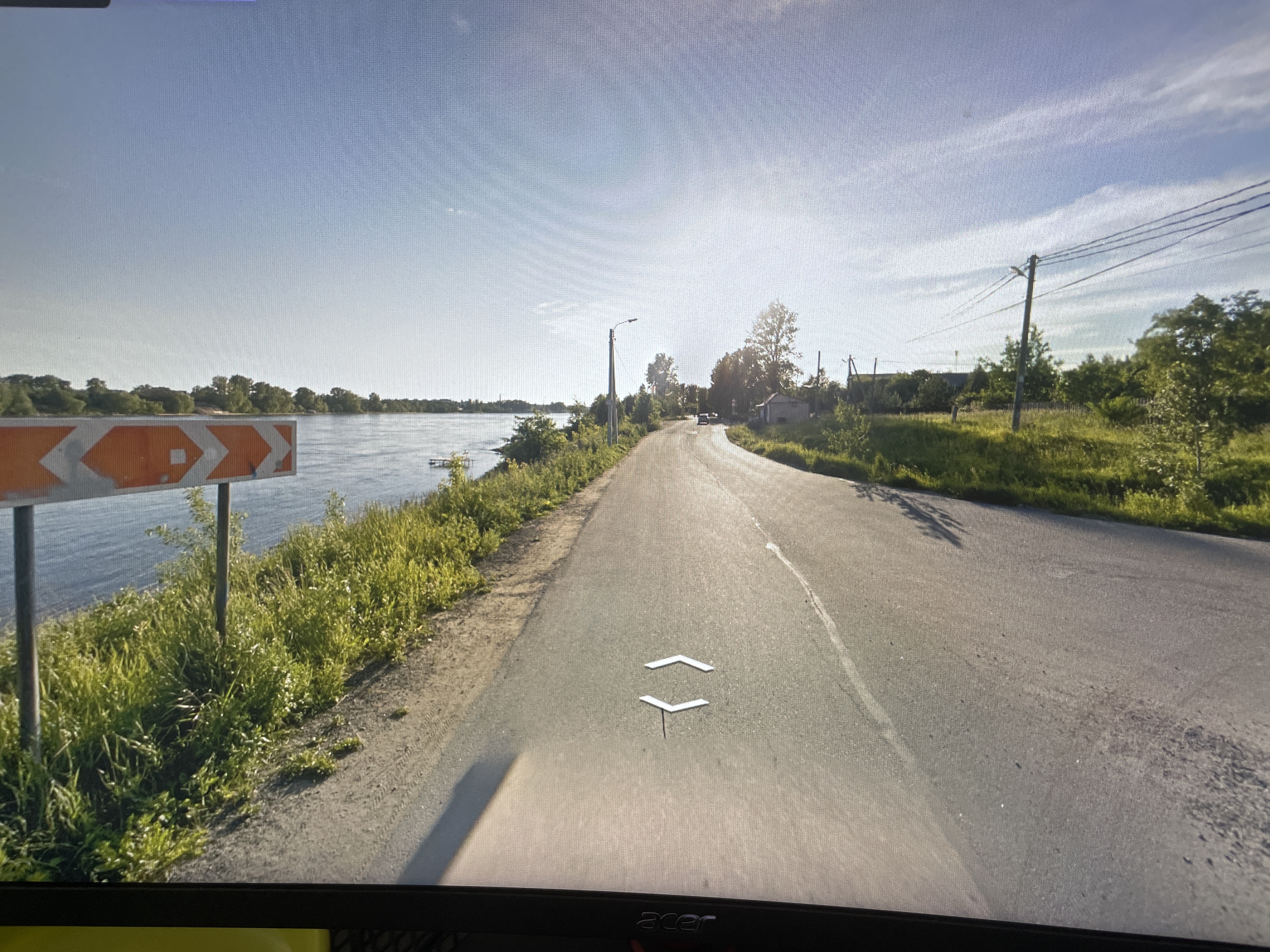
Primary guess
Rural road along the Volga River, Russia
Confidence
• Level: Medium
• Why:
- The chevron sign style (horizontal orientation, color pattern, and placement on a support frame) is characteristic of road safety infrastructure in post-Soviet states, particularly Russia.
- The landscape—wide river, flat terrain, grassy banks, and simple asphalt road—is very typical of the Russian countryside along major rivers like the Volga.
- The specific color of the chevron sign (often red/white or orange/white in these regions) matches those used to delineate riverbanks or dangerous curves in Russia.
Visual evidence
• **Chevron Sign:** The large horizontal sign with alternating orange/white chevrons is a standard hazard marker used in Russia to indicate the edge of the road, particularly near riverbanks, steep embankments, or sharp bends.
• **Road Infrastructure:** The asphalt road without a solid center line, the rural nature of the surroundings, and the simple, functional design of the sign supports are consistent with secondary roads in Russia.
• **Environment:** The wide, calm river and the flat, green, sparsely wooded landscape strongly point to the vast floodplains of major Russian rivers.
• **Climate/Lighting:** The clear, bright, low-angle sunlight suggests a high-latitude region during summer, where daylight hours are long and the sun remains at a lower angle for significant parts of the day.
Reasoning
The visual cues point strongly toward a rural location in the Russian Federation. The chevron sign is a specific type of hazard marker used to warn drivers of a drop-off or riverbank. While similar signs are used globally, the specific aesthetic of the sign (the metal frame, the paint style, and the way it is mounted on two simple poles) is highly evocative of standard Russian road maintenance. The terrain is flat, suggesting the river is a major waterway (like the Volga or its tributaries), and the overall rural, unmanicured appearance is typical of the Russian interior. Alternative locations in Central or Eastern Europe are possible but less likely given the specific "feel" of the road construction and signage, which strongly matches common Russian infrastructure design.
Verification
• Road signs in Russia often follow the 1968 Vienna Convention but have specific implementations for hazard markers, including the use of chevron-patterned boards for delineating dangerous road edges.
• Search results confirm the prevalence of these types of "chevron" markers along riverbanks and dangerous curves in the Russian Federation.
Links
• Road signs in Russia (Wikipedia)
Coordinates
Approximate location: 56°00'N 45°00'E (This is a representative point in the Volga region; the exact location is likely along a river bend in rural European Russia).