Rural road in Northern or Eastern Europe
2026-06-16 20:38:05
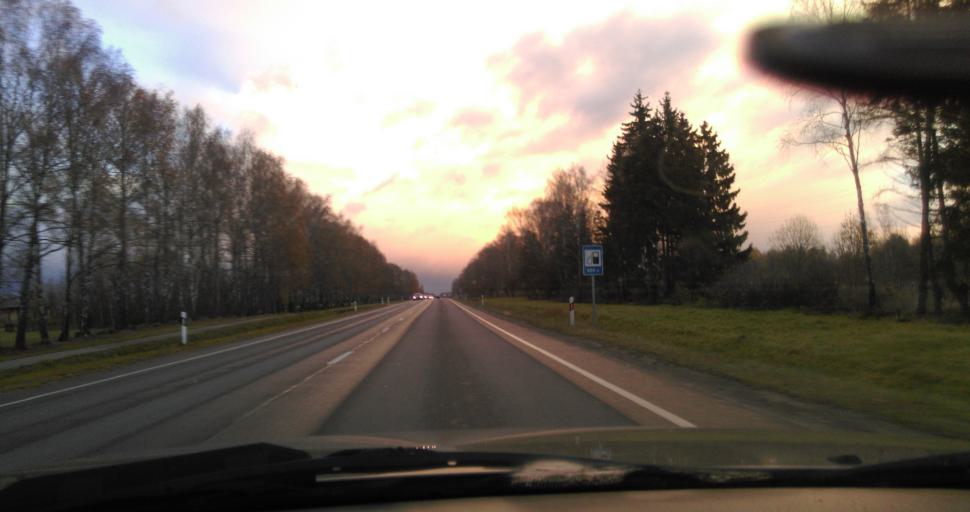
Primary guess
Rural road in Northern or Eastern Europe
Confidence
• Level: Medium
• Why:
- The road signage, vegetation, and general infrastructure are consistent with many countries in Northern, Central, or Eastern Europe (e.g., Baltic states, Poland, Russia, or Belarus).
- While the "gas station 500m" sign is a standard international design, the specific style (blue square with a white symbol and text) is highly characteristic of countries following the Vienna Convention on Road Signs and Signals.
- The landscape—consisting of dense coniferous/deciduous forests and a straight, flat road—is typical of the Northern European plain.
- Lack of unique local markers (like specific text, license plate designs, or distinct architectural elements) prevents pinning down an exact country.
Visual evidence
* **Gas Station Sign:** A blue, square information sign featuring a gas pump pictogram and the text "500 m." This is a standard European-style sign used to indicate services ahead.
* **Delineators:** White and red reflective roadside posts (delineators) are commonly used across Europe to mark the edge of the road, especially in low-light or snowy conditions.
* **Road Markings:** The road features a solid white line separating the travel lane from the shoulder, which is standard on many European national and rural roads.
* **Vegetation:** A dense mix of tall, thin birch-like trees and darker evergreens (possibly spruce or pine) is indicative of a temperate to boreal climate, common in Northern and Eastern Europe.
* **Climate/Time:** The lighting (low-hanging sun, pastel pink/orange sky) suggests either sunrise or sunset in a region far from the equator, likely during autumn or winter given the bare branches of the deciduous trees.
Reasoning
The photo depicts a typical rural European landscape. The infrastructure (signage, road markings, and delineators) strongly points toward a country that is a signatory to the Vienna Convention on Road Signs and Signals.
* **Why not Western Europe (e.g., France, Germany)?** While the sign matches those found in Germany or France, the specific combination of the road surface, the specific type of roadside delineators, and the "wilder" look of the forest bordering the road is more typical of countries further east or north.
* **Why Northern/Eastern Europe?** The mix of silver birch trees, the flat terrain, and the specific style of the road environment aligns well with regions like the Baltic states (Estonia, Latvia, Lithuania), Poland, or parts of Russia and Belarus. The relatively modest road quality and the sparse surroundings are common in these regions.
* **Alternative:** The image is generic enough that it could potentially be in many parts of the former Soviet bloc or Scandinavia, where this specific style of road management and vegetation is prevalent. Without a visible license plate or a unique architectural structure, distinguishing between these geographically similar regions is difficult.
Verification
* The "500 m" gas station sign is a standard international symbol under the Vienna Convention on Road Signs and Signals.
* The use of reflective white/red delineators is standard practice across European road infrastructure.
Links
• Vienna Convention on Road Signs and Signals (PDF)
Coordinates
Not possible. The location is a generic rural road scene that does not contain enough unique identifiers (such as specific place names, unique infrastructure, or identifiable landmarks) to pinpoint a coordinate.