Sahel region, West Africa (likely Mali, Niger, or Chad)
2026-08-03 05:21:51
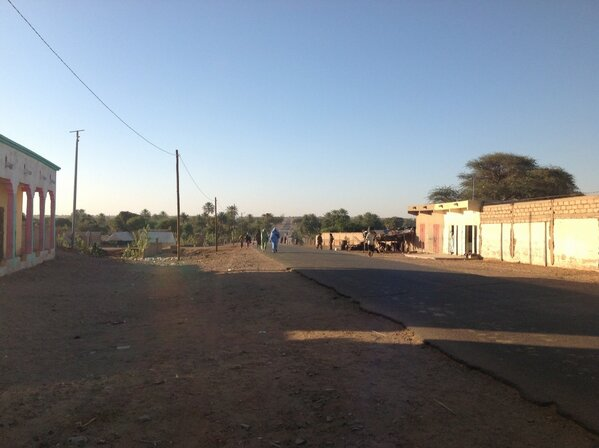
Primary guess
Sahel region, West Africa (likely Mali, Niger, or Chad)
Confidence
• Level: Medium
• Why:
- The architectural style, characterized by earthen construction and simple rectangular forms, is iconic to the Sudano-Sahelian region.
- The landscape—arid, dusty, with low-lying desert vegetation—perfectly matches the ecoclimatic transition zone of the Sahel.
- The blue clothing worn by individuals is a cultural hallmark of nomadic and semi-nomadic groups (such as the Tuareg) common to this specific geographic belt.
- While the scene is highly representative of this region, it is generic enough that pinpointing a specific village or road is impossible without more specific landmarks or signage.
Visual evidence
• **Architecture:** The buildings feature flat roofs, earthen/adobe-colored walls, and a lack of modern ornamentation, characteristic of traditional and semi-modern dwellings in the Sahel.
• **Vegetation:** Sparse, drought-resistant trees and scrub brush in the distance are indicative of a semi-arid, hot climate.
• **Clothing:** Several individuals are wearing distinctive blue robes (boubous) and head coverings, which are frequently associated with Tuareg populations and other desert-dwelling peoples of West Africa.
• **Road:** The paved road suggests this is a main route connecting settlements in a rural area, typical of infrastructure development projects in Sahelian countries.
• **Climate/Atmosphere:** The clear blue sky, harsh sunlight, and dusty, unpaved shoulders indicate a dry, desert-adjacent environment with high heat.
Reasoning
The visual elements of the image align strongly with the geographical and cultural characteristics of the Sahel, a semi-arid transition zone spanning several African nations. The combination of adobe-style architecture, the presence of people in traditional blue nomadic-style attire, and the dry, expansive landscape are classic markers of countries like Mali, Niger, or Chad.
Alternative locations, such as North Africa (Morocco/Algeria) or East Africa, were considered but are less likely. While similar clothing styles exist in North Africa, the specific architectural "feel" of these modest, block-like structures often points more strongly to the Sudano-Sahelian belt. No specific road signs, license plates, or unique architectural monuments are visible to narrow the location down to a specific town or coordinate set.
Verification
• Sudano-Sahelian architecture (Wikipedia)
• The Sahel region overview (Spatial Agent)
• Tuareg cultural dress (Alamy)
Links
• OpenStreetMap - Sahel Region
Coordinates
• It is not possible to provide precise coordinates. The image captures a rural or semi-urban road in the Sahel; without further context (e.g., specific town names or road markers), the location cannot be geolocated beyond the broader regional classification.