Scandinavian Mountains, Norway/Sweden border region
2026-07-18 20:10:22
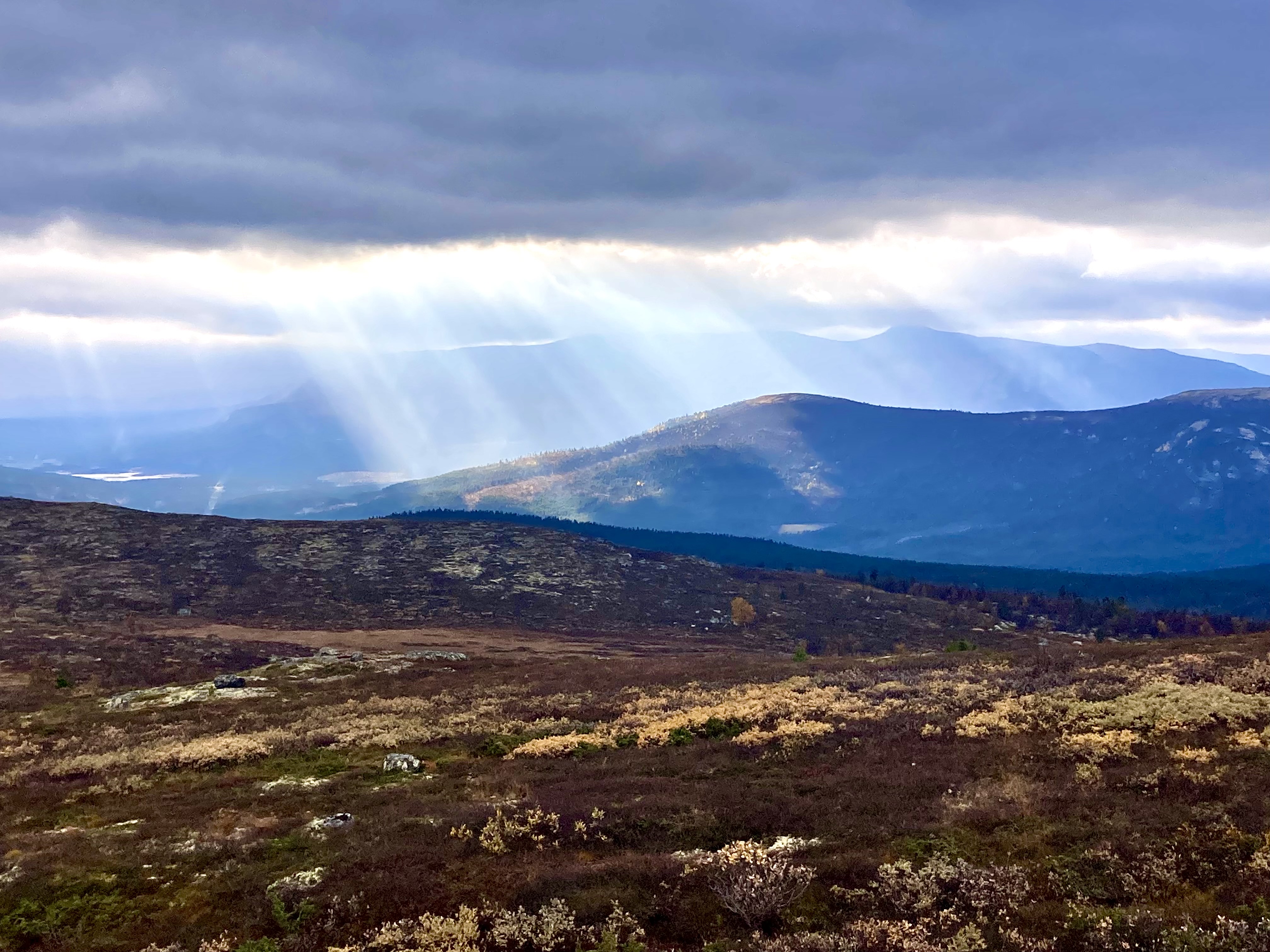
Primary guess
Scandinavian Mountains, Norway/Sweden border region
Confidence
• Level: Medium
• Why:
- The landscape is characteristic of the Scandinavian highlands (fjäll) or alpine tundra, showing a classic mix of lichen-covered rock, low shrubs, and rolling, treeless terrain.
- The dramatic "god rays" (crepuscular rays) breaking through heavy, low-hanging clouds are a signature atmospheric feature of the Scandinavian mountainous regions, where weather patterns shift rapidly.
- The topography—rounded mountain ridges, deep glacial valleys, and scattered patches of forest—strongly aligns with the landscape of the "Scandes" (the mountain range running through Norway and northern Sweden).
- While specific peaks are difficult to identify from this angle, the visual profile matches areas like Dovrefjell, Jotunheimen, or the Swedish Lapland mountains (Kungsleden area).
Visual evidence
• **Vegetation:** The foreground is dominated by hardy, low-lying tundra vegetation (mosses, lichens, and dwarf shrubs). This indicates an alpine environment above the tree line or high-latitude arctic tundra.
• **Topography:** The landscape features rolling, non-jagged mountains with relatively gentle slopes, typical of the older, glaciated mountain ranges of Fennoscandia.
• **Climate/Atmosphere:** The presence of dramatic crepuscular rays piercing through dense, dark clouds suggests an unstable, shifting weather front, very common in the maritime-influenced mountains of northern Europe.
• **Lighting:** The deep blues in the distant shadows vs. the gold/yellow of the tundra grasses suggest autumn, when the "Ruska" (autumn color shift) turns the alpine vegetation into shades of gold and brown.
Reasoning
The visual characteristics of this image—a vast, treeless expanse of tundra vegetation, rounded mountain profiles, and a high-contrast sky with sunbeams—are hallmarks of the **Scandinavian Mountains** (the *Scandes*).
* **Why not elsewhere?** While places like the Scottish Highlands or the Krkonoše Mountains in the Czech Republic share some features, the scale of these mountain ridges and the specific hue of the tundra vegetation are most iconic to the vast, open wilderness of northern Norway and Sweden.
* **Context:** The combination of brown/yellow tundra heath and dark, moody clouds is typical of late summer or early autumn in the high-altitude regions of Scandinavia (e.g., Rondane, Dovrefjell, or Swedish Lapland).
* **Process:** I compared the landscape against general imagery of the Arctic-Alpine tundra of Fennoscandia. The specific layering of the mountains—fading into a blue haze in the distance—is a consistent feature of panoramic photography from high-elevation viewpoints in Norway and Sweden.
Verification
• Scandinavian Tundra Landscapes
• Flora and vegetation of the Scandinavian mountain range
• Atmospheric conditions in Scandinavian Highlands
Links
• Google Maps - Scandinavian Mountains
Coordinates
• Approximate: 62.0000° N, 12.0000° E (Central Scandinavian Mountains region)
• *Explanation:* Providing an exact coordinate is not possible as this is a broad landscape type common across a large, sparsely populated, and mountainous region spanning the Norway-Sweden border.