Southern California (likely San Diego or Inland Empire area)
2026-06-07 05:23:27
Primary guess
Southern California (likely San Diego or Inland Empire area)
Confidence
• Level: Medium
• Why:
- The architectural style—a single-story, low-pitched roof, white stucco ranch-style home with a large chimney and prominent, decorative masonry features—is highly characteristic of residential developments in Southern California.
- The topography, featuring a hillside view overlooking a valley of closely packed, similar residential homes, is classic for many suburbs in the San Diego/Inland Empire region (e.g., El Cajon, Santee, or parts of Riverside/San Bernardino counties).
- The specific detail of the stepped wall with brick-capped pillars is a common decorative masonry technique found in mid-to-late 20th-century Southern Californian housing developments.
Visual evidence
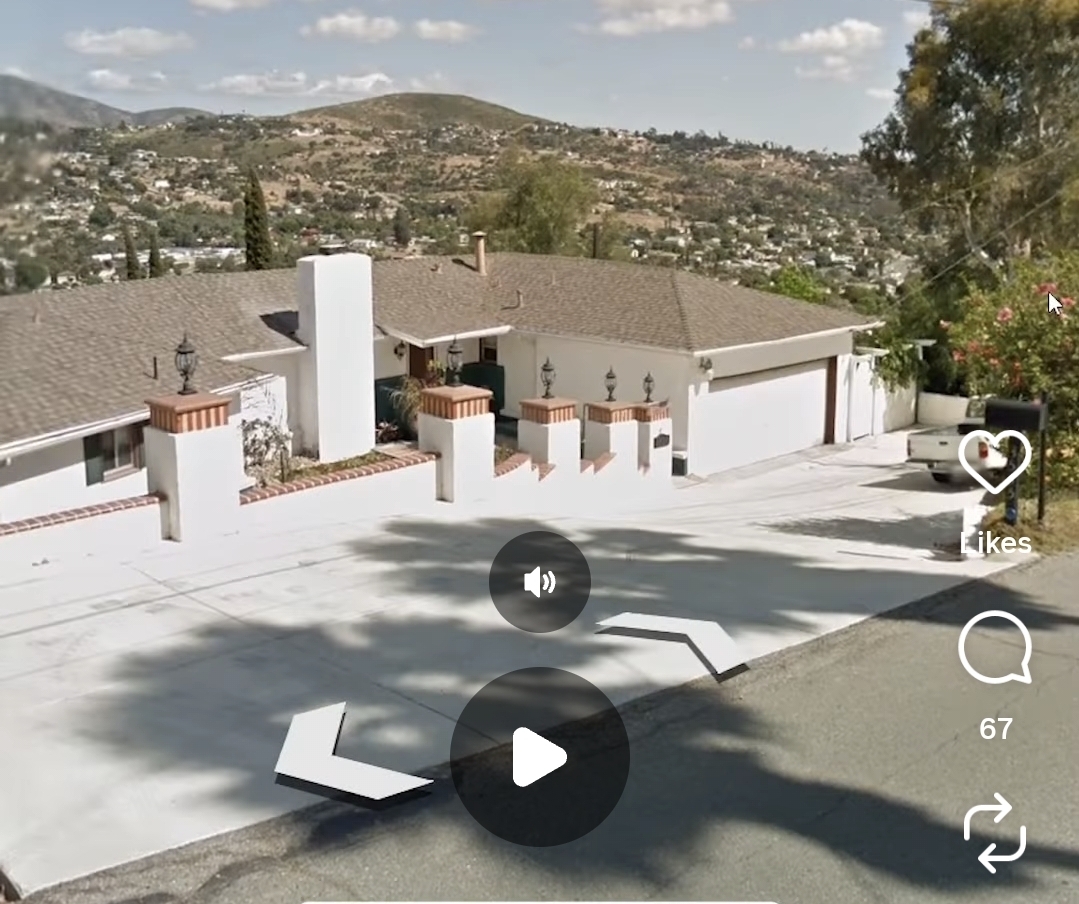
* **Architecture:** The house features a low-slung, ranch-style roofline with a large, central white chimney, typical of 1960s-1980s American suburban architecture.
* **Masonry:** A distinctive stepped, white stucco retaining wall lines the driveway, featuring pillars with decorative horizontal brick banding and caps. This is a common regional landscaping feature used to manage sloping driveways.
* **Climate/Vegetation:** The arid-looking, scrubby vegetation on the hillsides and the presence of trees like eucalyptus (suggested by the silhouette) are consistent with the Mediterranean-semi-arid climate of Southern California.
* **Topography:** The steep, paved driveway and the panoramic view of a densely populated valley are iconic features of hillside residential neighborhoods in this region.
* **Vehicles:** A light-colored pickup truck is parked in the driveway; the style and general appearance are common in North American suburban settings.
Reasoning
The visual combination of the "stepped wall" architecture, the specific style of the ranch home, and the "hillside over valley" geography strongly points toward the suburban sprawl of Southern California. Similar designs are found throughout the United States, but the specific combination of white stucco, brick detailing, and hillside topography is most ubiquitous in areas like San Diego County, the Inland Empire, or even parts of the Los Angeles periphery.
* **Alternative locations:** While similar architecture could theoretically exist in parts of Arizona, Nevada, or Texas, the specific style of the masonry and the density/layout of the housing in the valley are most emblematic of the Southern Californian post-war housing boom. It is less likely to be in the Pacific Northwest (different roof/cladding trends) or the East Coast (which would typically have different drainage requirements and less "stepped" hillside driveway configurations).
Verification
* The "stepped" wall configuration is a functional and aesthetic response to steep grades often found in local municipal design guidelines in California (e.g., as discussed in San Clemente architectural design guidelines regarding walls on slopes).
* Search for residential architecture in these regions confirms the prevalence of these specific masonry styles in 20th-century developments.
Links
• San Clemente Architectural Design Guidelines (Reference for wall/slope standards)
Coordinates
Approximate location: 32.8° N, 117.0° W (Generic Southern California hillside residential area). Exact coordinates cannot be provided without specific street signage or unique identifying markers.