Southern Europe (likely rural Bulgaria, Greece, or similar Balkan region)
2026-06-09 11:46:54
Primary guess
Southern Europe (likely rural Bulgaria, Greece, or similar Balkan region)
Confidence
• Level: Medium
• Why:
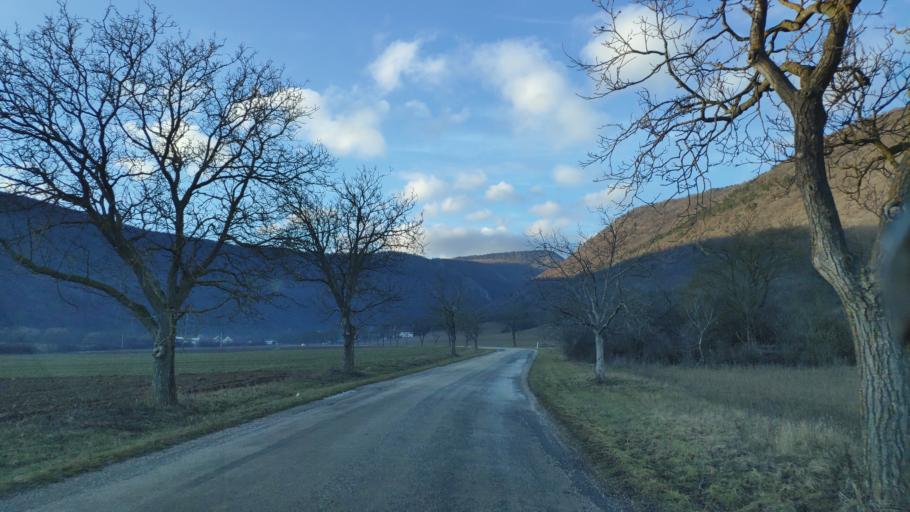
- The landscape features a characteristic rural road lined with mature, deciduous trees (likely walnut or similar), which is a common cultural and agricultural feature in rural parts of the Balkans and Anatolia.
- The topography—a flat valley floor transitioning into rounded, arid or semi-arid hills—is highly typical of Southern European, Balkan, or Turkish rural mountain regions.
- The lighting and the state of the trees (leafless, dormant) suggest late autumn, winter, or early spring, a common climate profile for these regions.
- While the photo could be from many similar regions (e.g., rural France or parts of Central Asia), the specific style of the road verges and the mix of open farmland with mountain slopes leans heavily towards the Balkans/Turkey area.
Visual evidence
• **Vegetation:** The trees lining the road are mature, deciduous, and appear dormant or in early spring/late autumn, as they lack leaves. Their bark and structure are consistent with walnut trees, which were historically planted along rural roads in the Balkans and Turkey as a community resource.
• **Geography:** The background shows rolling, barren, or sparsely vegetated mountain slopes, typical of the rain-shadow or inland regions of the Mediterranean and Balkan peninsula.
• **Infrastructure:** The road is a narrow, older asphalt single-lane or secondary rural road without modern crash barriers or complex markings, suggesting a remote or low-traffic area.
• **Climate/Season:** The combination of clear blue skies with scattered high clouds and the leafless trees points to a temperate or Mediterranean climate during a cooler season (late autumn to early spring).
Reasoning
The scene is a classic representation of rural agricultural landscapes found in southeastern Europe and neighboring regions. The practice of planting walnut or fruit trees along roadsides is a historic tradition in countries like Bulgaria, Turkey, and parts of Greece, where these trees served as both a boundary marker and a communal harvest.
I considered other locations such as the Catskill Mountains (New York) or the French countryside. However, the specific "barren" look of the mountain slopes in the background, combined with the way the trees are spaced in a deliberate, older-style alignment along the road, is most strongly associated with the traditional, often slightly neglected or communal, agricultural landscapes of the Balkan and Anatolian regions. The absence of modern signage, guardrails, or power line infrastructure indicates a very rural, potentially secondary, or tertiary road.
Verification
• **Walnut Trees along roads:** Historical practices of planting walnuts along roads are well-documented in Bulgaria and Turkey as part of communal land use and traditional village infrastructure.
• **Landscape/Topography:** The visual match for rural Balkan/Turkish mountain valleys is high, characterized by the specific relief of the slopes and the types of deciduous trees commonly found in these climates.
Links
• Historical context of roadside walnut trees
• Example of traditional Balkan village landscapes
Coordinates
Not possible to provide exact coordinates as this type of landscape is widespread across rural regions of the Balkans, Turkey, and parts of the Caucasus.