Spain
2026-06-04 21:07:50
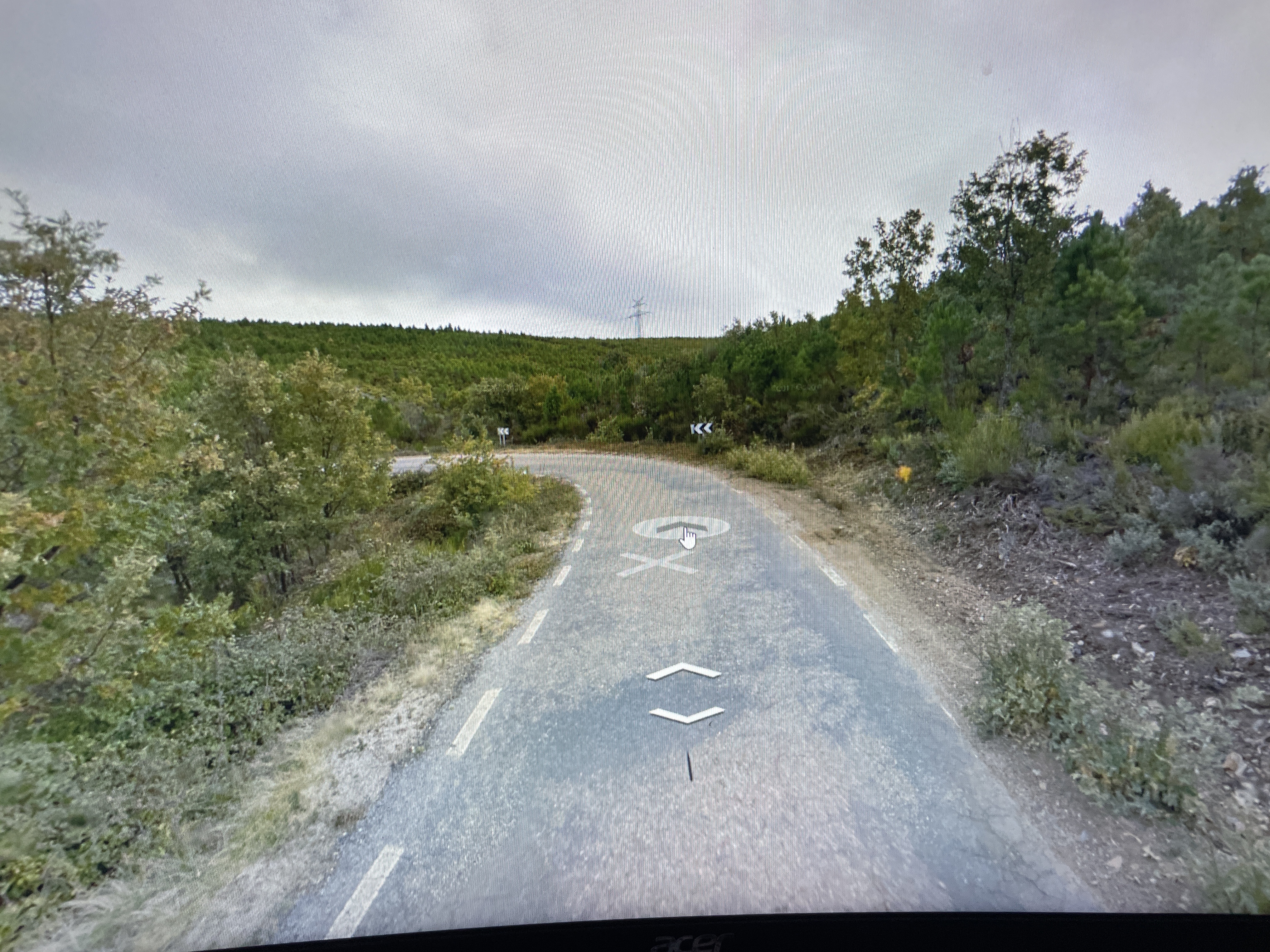
Primary guess
Spain
Confidence
• Level: High
• Why:
- The road markings (white dashed lines along the sides and the specific style of the chevron sign) are highly characteristic of rural Spanish roads.
- The chevron signage ("<<") used for marking sharp curves is a standard element of the Spanish road network.
- The landscape—characterized by Mediterranean-style scrubland and pine-covered hills—is extremely common in the rural interior and mountainous regions of Spain.
Visual evidence
• **Chevron Signage:** The "<<" sign is a classic hazard marker used across Spain to indicate a sharp bend in the road. These are often found in white-and-blue or black-and-white configurations.
• **Road Markings:** The white dashed lines along the edges of the pavement (often referred to as *cebreado* when used as chevrons, though here serving as edge markers) are typical for narrow, rural Spanish roads where they delineate the driving area.
• **Vegetation:** The mix of low, hardy shrubs and pine trees is representative of the Mediterranean climate found in much of Spain's topography.
• **Infrastructure:** The simple, unadorned metal posts and the general condition of the asphalt are consistent with secondary or rural roads in the Spanish countryside.
Reasoning
The visual cues strongly point toward Spain. Specifically, the combination of the specific chevron hazard markers—which are mandated by Spanish road norms for sharp curves—and the white painted edge markings confirm the location as a Spanish rural road. Similar landscapes and signage exist in Portugal and parts of France, but the specific "<<" chevron design and the style of the road markings are most frequently associated with the Spanish *Dirección General de Tráfico* (DGT) standards. The terrain is typical of the Spanish *sierras* or highland interior, where such winding roads are common. There is no evidence of distinctive markings or signage that would suggest a location outside of the Iberian Peninsula.
Verification
• Road signs in Spain follow the Vienna Convention and use specific chevron designs for curve warnings.
• The use of edge markings on narrow roads is a standard practice in Spain to guide drivers.
• Examples of these exact signs in mountainous Spanish regions can be found in stock imagery and geographical reference databases.
Links
• General Information on Spanish Road Signs (N332.es)
• Wikipedia: Road signs in Spain
Coordinates
Not possible. The scene is a generic rural road with no identifiable landmarks, town names, or unique infrastructure, making specific geolocation via latitude/longitude unfeasible without further context.