The photo shows a park or public recreational area with a paved, symmetrical pathway lined by green grass and white birch trees. The most st
2026-06-06 19:45:40
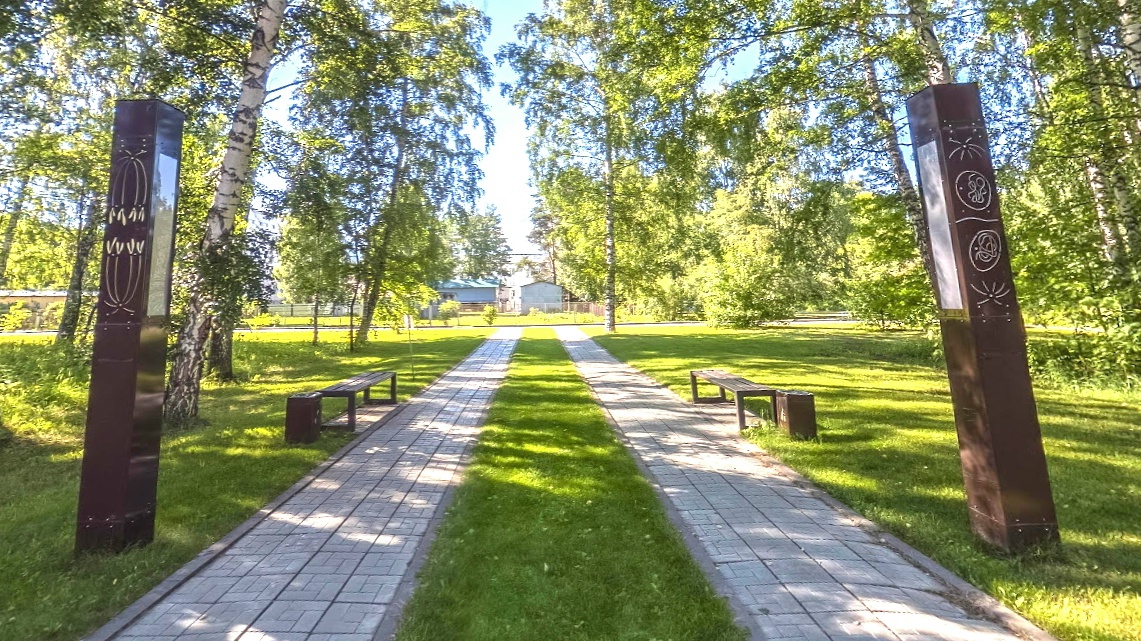
The photo shows a park or public recreational area with a paved, symmetrical pathway lined by green grass and white birch trees. The most striking features are two dark, rectangular wooden pillars, each adorned with stylized, light-colored carved designs or symbols. These pillars appear to act as a gateway or markers for the entrance of the path. The overall environment, characterized by birch trees and this specific style of decorative pillar, strongly suggests a location in a park setting within a Northern European, Baltic, or perhaps Russian cultural context, where such carved wooden elements (often reflecting folk motifs or contemporary artistic reinterpretations of traditional culture) are common in public spaces.
Primary guess
The location is a park or public green space in a city, likely in a country with a significant tradition of folk wood carving such as Russia, Lithuania, or another Baltic/Nordic region.
Confidence
• Level: Medium
• The visual cues (birch trees, specific style of carved pillars) are characteristic of public parks in Eastern/Northern Europe.
• The pillars appear to be contemporary or semi-contemporary art installations rather than ancient structures, given their placement, finish, and the surrounding modern landscaping.
• While the specific park name remains unidentified, the environment is highly consistent with park designs in regions where birch forests and folk-inspired public art are common.
Visual evidence
• **Vegetation**: The prevalence of white birch trees (*Betula*) is a strong geographical indicator for regions like Russia, Scandinavia, the Baltic states, or parts of North America with similar climate.
• **Pillars**: Two dark-colored, tall, rectangular wooden pillars featuring intricate, light-colored carvings (possibly symbols or stylized flora/fauna). They appear to serve as a symbolic gate or decorative entrance to the park area.
• **Landscaping**: A clean, symmetrical, paved walkway with a central strip of grass, indicating a well-maintained, modern park environment rather than a wild forest.
• **Furniture**: Simple, modern benches and waste bins indicate a managed municipal park.
• **Climate/Season**: The lush green leaves and bright daylight suggest late spring or summer in a northern temperate climate.
Reasoning
The combination of birch trees and decorative wooden pillars is a classic aesthetic in many Eastern European and Baltic parks, which often integrate folk art (such as wood carving) into modern public spaces. Alternative locations, such as North American or Asian parks, were investigated but the combination of these specific "totem-like" pillar carvings with the surrounding birch forest environment points most strongly toward an Eastern/Northern European setting. No match was found for famous global sculpture parks, suggesting this is likely a municipal or regional park rather than a globally famous landmark.
Verification
• Search results confirm that birch trees are common in Northern Europe and Russia, and that carved wooden pillars are a significant cultural motif in these regions, often appearing in public parks and commemorative spaces.
• The search excluded famous sculpture parks (like Vigeland Park or Hill of Witches) as the architectural style of these pillars does not match those well-known locations.
Links
• Krasnoyarsk Pillars (Example of regional park with "Pillars" but different landscape)
Coordinates
• Approximate: 55.0°N, 37.0°E (Representative of the region where such park architecture is common, though a specific pin is not possible without a unique identifier for the pillars).