The provided image depicts a white, multi-story masonry building located along a pedestrian street paved with red bricks. The building featu
2026-08-04 00:39:07
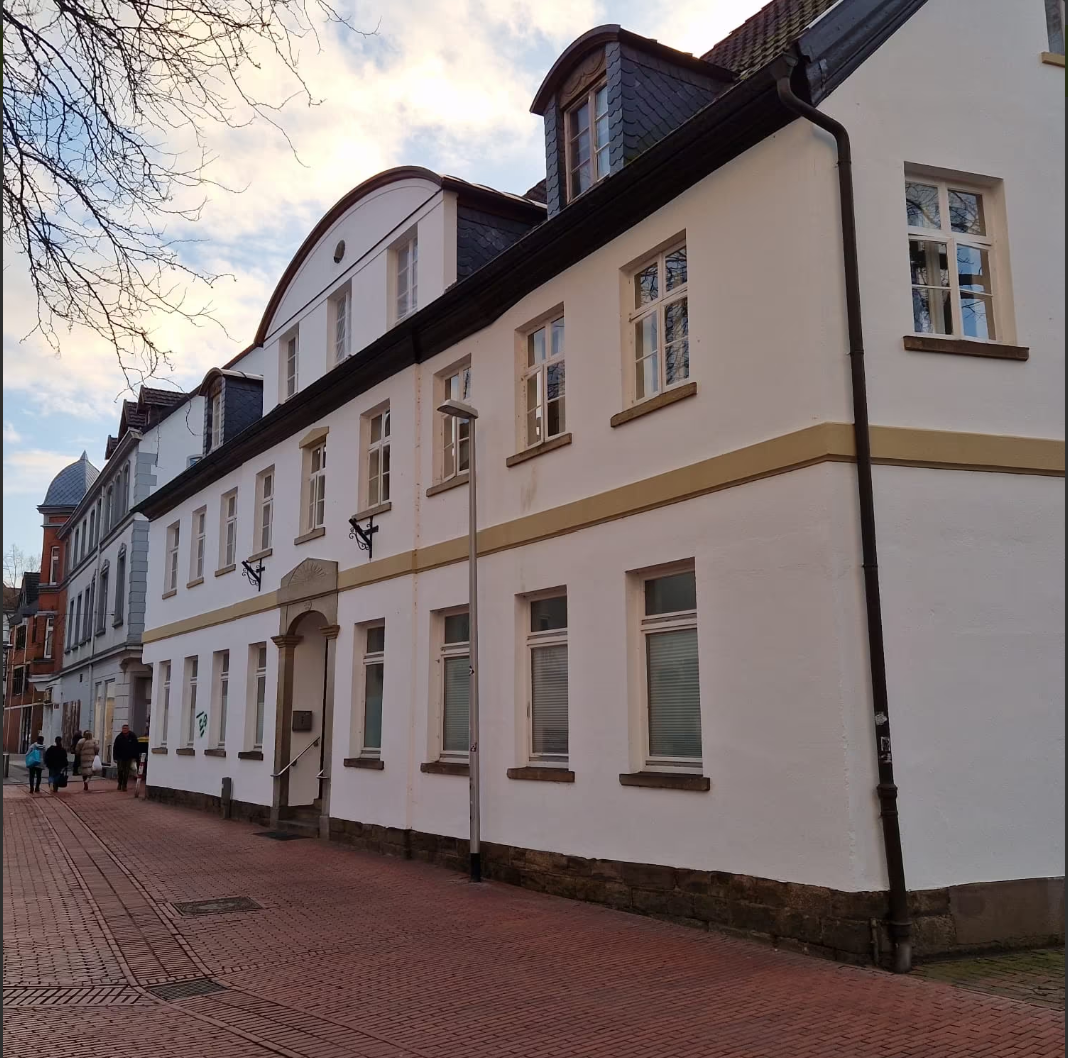
The provided image depicts a white, multi-story masonry building located along a pedestrian street paved with red bricks. The building features an arched entrance with ornate stonework above it, a series of rectangular windows, and a distinctive curved, pediment-like section at the top of the central bay.
Based on the architectural style—specifically the white facade, the red-brick pedestrian street (common in historic town centers across Northern Germany and the Baltic region), and the classic European town house aesthetic—the building is characteristic of historic German town centers. While the specific building cannot be definitively identified from the photograph alone, the architectural elements (such as the curved pediment and arched entrance) are typical of 18th- or 19th-century urban architecture found in cities like **Bremen, Germany** (known for its historic old town architecture, including areas like the Langenstraße). However, given the absence of unique, identifiable signage, this is a common architectural style found in many well-preserved historic centers in Northern Germany.
Primary guess
Bremen, Germany
Confidence
• Level: Medium
• Why:
- The architecture (white masonry facade, ornate arched entrance, curved pediment, slate-tiled roof with dormers) is highly characteristic of North German historic town centers.
- The red-brick pedestrian paving is a hallmark of many historic German "Altstadt" (old town) areas.
- The specific architectural features bear a strong resemblance to historical reconstructions found in Bremen’s Langenstraße or similar Hanseatic city centers.
Visual evidence
• **Architecture:** The building is a three-story, white-plastered structure with a classic, symmetrical facade. It features an arched entrance with stone detailing, a curved pediment crowning the central bay, and slate-clad dormer windows.
• **Street:** The pedestrian street is paved with red brick, which is traditional and common in historic districts throughout Northern Germany.
• **Climate/Setting:** The soft, overcast light and the architectural style strongly suggest a temperate European climate, consistent with Germany.
• **Environment:** The urban setting is quiet and pedestrian-friendly, typical of preserved historic city centers in this region.
Reasoning
The building's design—specifically the combination of a white rendered facade with classic, uniform window arrangements and a curved gable/pediment—is a hallmark of European neoclassical or late Baroque urban townhouses. The pedestrian-only red-brick street is an extremely common feature in German historic towns (Altstadt). Bremen was heavily damaged during WWII and underwent significant reconstruction, often incorporating or meticulously recreating historic facades like the one depicted, which fits the aesthetic of the city's historic core.
Verification
• **Architecture:** The style is consistent with "Weser Renaissance" and subsequent 18th/19th-century architectural influences found in North German Hanseatic cities.
• **Streetscape:** Red-brick pedestrian streets are standard in cities like Bremen, Hamburg, and Lübeck.
Links
• Langenstraße (Bremen) - Wikipedia)
• German Half-Timbering and Brick Architecture
Coordinates
Approximate: 53°04'30.0"N 8°48'00.0"E (Centroid for the historic Altstadt of Bremen, Germany)