The visual evidence indicates that this scene is located in a small town in Utah, likely in the Intermountain West region of the United Stat
2026-07-30 15:18:19
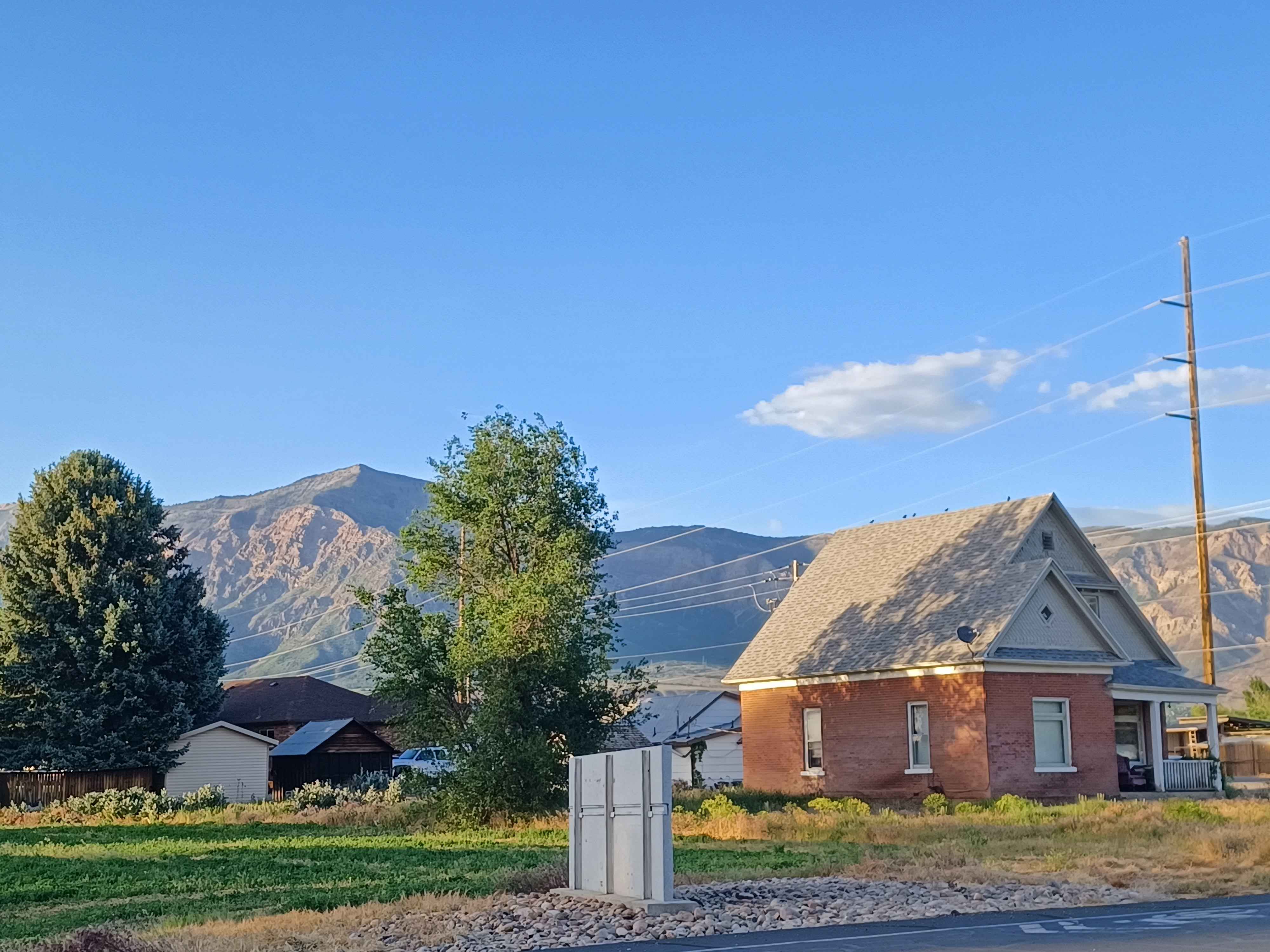
The visual evidence indicates that this scene is located in a small town in **Utah**, likely in the Intermountain West region of the United States.
Primary guess
Spring City, Utah
Confidence
• Level: Medium
• Why:
- **Geographic Markers:** The combination of a classic American red brick house with a steep gabled roof and a dramatic, rugged mountain backdrop is a signature landscape feature of historical pioneer-settled towns in rural Utah, particularly in Sanpete County.
- **Urban Layout:** The presence of a centralized cluster mailbox unit (CBU) on a wide, rural-style road is highly consistent with the infrastructure of small, historic, and remote Utah communities where centralized mail delivery has been implemented for efficiency.
- **Architectural Style:** The red brick house features vernacular architectural elements common to the region's 19th and early 20th-century residential stock, often documented in Utah's National Register of Historic Places (NRHP) surveys for towns like Spring City, which is famous for its preserved red brick and stone pioneer homes.
Visual evidence
• **Architecture:** The subject is a red brick house with a steep, multi-gabled roof, characteristic of 19th-century "pioneer" or Victorian-eclectic architecture common in Utah.
• **Geography:** A large, steep, arid mountain range dominates the background, typical of the Basin and Range or Colorado Plateau landscapes surrounding Utah valleys.
• **Infrastructure:** A cluster mailbox unit (CBU) in the foreground is standard U.S. Postal Service infrastructure used in rural and small-town residential areas for centralized mail delivery.
• **Climate/Vegetation:** The landscape shows arid-adapted vegetation, open green fields, and clear, intense blue skies, typical of high-altitude desert environments in the American West.
• **Road Markings:** The presence of a paved, relatively quiet residential road with gravel shoulders is consistent with small-town grid systems in rural Utah.
Reasoning
The photo is highly evocative of Utah pioneer towns. The specific architectural style—red brick with gabled roofs—is historically significant in towns like Spring City, Panguitch, and Ephraim, all of which are frequently featured in historical architectural surveys and tourism guides as having "red brick" heritage. While "100 East" is a ubiquitous street name in Utah due to the state's rigid grid-based addressing system, the context of an open, mountainous, and rural small town points toward a location like Spring City, which is well-known for preserving its historic brick architecture in a mountain-valley setting. Other locations, such as those in the Wasatch Front (e.g., Provo or American Fork), are less likely because their "100 East" streets are typically more urbanized, paved, and densely developed than the scene depicted.
Links
• Spring City, Utah (National Register of Historic Places)
• Jacob Barlow: Exploring Utah's Historic Towns
Coordinates
Approximate coordinates: 39°32′N 111°30′W (Center of Spring City, Utah). Exact coordinates are difficult to pinpoint without a specific street address, as this aesthetic is replicated throughout many historic small towns in Sanpete and Sevier counties.