Unknown location in rural China
2026-08-29 16:47:11
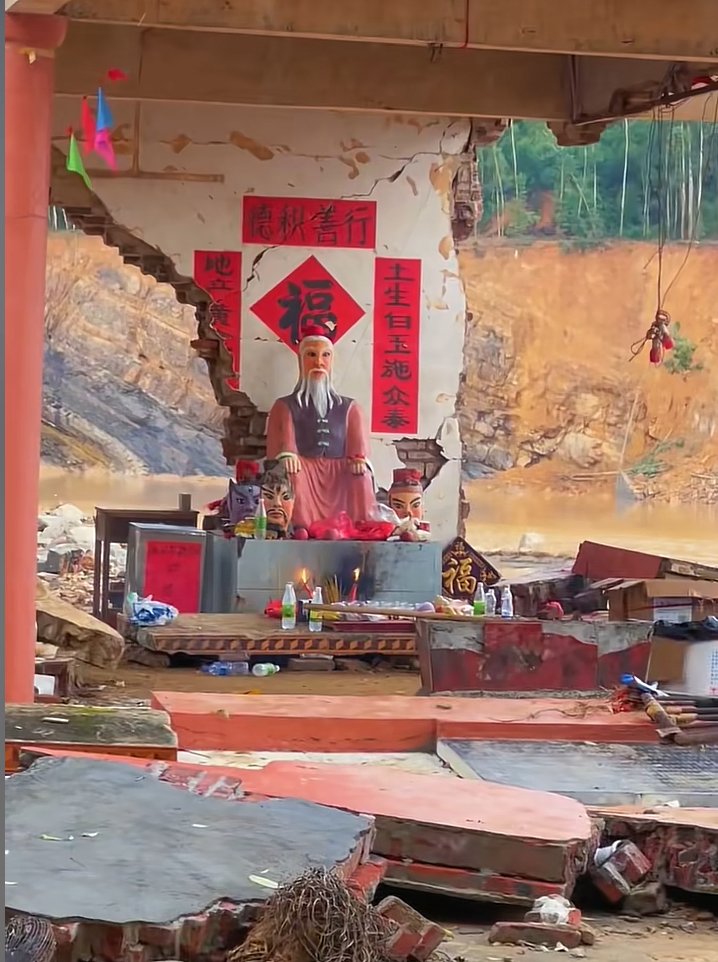
Primary guess
Primary guess: Unknown location in rural China
Confidence
• Level: Low
• Why:
- The image displays characteristics of a small, local, or possibly improvised shrine in rural China, rather than a famous or historically significant landmark.
- There is no specific signage or identifiable geographical landmark in the photo to pinpoint a city, province, or region.
- The surrounding terrain suggests a landscape undergoing earthworks, mining, or natural erosion, which are common in many rural parts of China.
Visual evidence
• **Architecture/Structure:** The shrine appears to be in a state of ruin or demolition, with significant structural damage to the walls. It lacks the formal, well-maintained appearance of a major tourist temple.
• **Language/Script:** The red banners feature traditional Chinese calligraphy. The text "德积善行" (Dé jī shàn xíng - "Accumulate virtue and do good deeds") and "土生白玉池众春" (a poetic phrase involving elements like "earth," "white jade pool," and "spring") are consistent with religious or folk belief inscriptions found in Chinese shrines.
• **Statue:** A central painted statue sits in the shrine, surrounded by smaller, mask-like figures. This style is typical of folk religion shrines or local deity temples.
• **Climate/Environment:** The background shows significant earth-moving activity, exposed soil, and muddy water. This suggests either an active construction/mining site, a landslide area, or rural land development.
• **Objects:** Modern plastic water bottles and miscellaneous offerings indicate that the site, despite its ruined state, may still be visited by locals.
Reasoning
The photo depicts a small, local Chinese shrine. These types of shrines are ubiquitous across rural China and are often dedicated to local deities, ancestors, or protective spirits. The visible damage (the crumbling concrete wall) and the backdrop of heavily disturbed, eroded earth (which looks like a quarry, a major construction site, or severe environmental degradation) suggest the site is likely being demolished or has been affected by local industrial activity or natural events.
Because such shrines are often unregistered, private, or local, they do not appear in international databases or on public maps. The calligraphy is common in Buddhist or Taoist folk contexts and does not provide a location-specific identifier. Alternative locations like major heritage sites are ruled out by the lack of historical architecture and the presence of modern, informal construction materials (e.g., standard concrete bricks, simple corrugated roof).
Verification
• Research into the specific calligraphy "土生白玉池众春" and "德积善行" did not yield results connecting them to a specific, identifiable site.
• The environment is highly indicative of rural Chinese landscapes where small religious sites often exist in close proximity to agriculture, mining, or industrial projects.
Links
• N/A