Wadi Musa, Jordan
2026-06-05 14:24:20
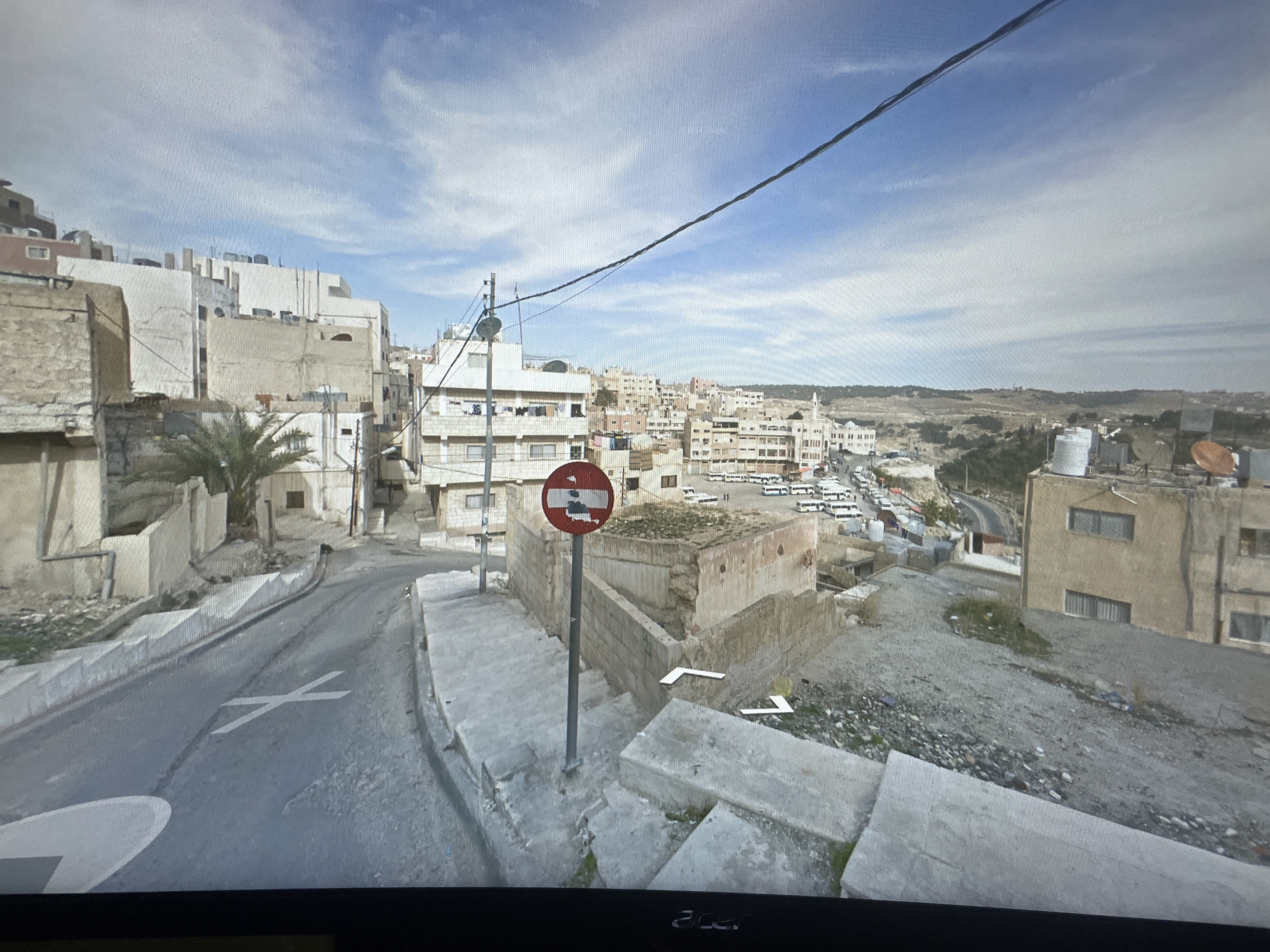
Primary guess
Wadi Musa, Jordan
Confidence
• Level: High
• The architecture (limestone buildings, terraced housing, desert/arid environment) is highly characteristic of towns in the southern highlands of Jordan, specifically Wadi Musa, which serves as the gateway to Petra.
• The "No Entry" sign follows the international standard used throughout Jordan.
• The road and landscape patterns match the hilly terrain surrounding Wadi Musa.
Visual evidence
* **Architecture:** The buildings are primarily constructed from light-colored, local limestone, which is the standard building material in towns like Wadi Musa and Amman. The structures are multi-story, terraced into the hillsides, and have flat roofs, typical of the region.
* **Signage:** The "No Entry" sign (red circle with a white horizontal bar) is a standard regulatory sign compliant with the Vienna Convention on Road Signs and Signals, which is used throughout Jordan.
* **Landscape/Climate:** The terrain is rugged, hilly, and arid, with sparse vegetation, consistent with the southern Jordanian highlands where the elevation and dry climate create a rocky, barren appearance.
* **Infrastructure:** The narrow, winding paved roads and the utility infrastructure (overhead power lines, concrete barriers) are common throughout residential areas in Jordanian hillside towns.
* **Vehicles:** The presence of white transit vans (visible in the parking area) is very common in Jordan, where they are frequently used for public transport and tourism shuttles between major hubs and sites like Petra.
Reasoning
The visual characteristics of this scene point strongly to a city in the Jordanian highlands.
1. **Geographic Identification:** The architectural style—specifically the use of beige/white limestone blocks, flat roofs, and the way the buildings are stepped up the side of a hill—is a signature of urban development in Jordan.
2. **Comparison:** While similar architecture can be found in parts of Palestine or Israel, the overall "feel" of the town, the specific style of the road infrastructure, and the prevalent use of these white shuttle-style vehicles strongly favor Wadi Musa.
3. **Alternative Locations:**
* *Amman:* While Amman also features these limestone buildings, it is much denser and more sprawling. The scale of the hills and the semi-rural, gateway-town vibe seen here is more characteristic of Wadi Musa.
* *Other Middle Eastern countries:* While many countries use the standard "No Entry" sign, the building materials (limestone) and the specific topography (steep, terraced hills) are less representative of other regional hubs like Dubai (which is flatter and more modern) or Egyptian cities (which often use different construction styles like concrete frames or brick).
Verification
* The use of limestone and the terraced landscape is well-documented for Wadi Musa and surrounding Jordanian towns.
* Jordanian traffic signs follow the Vienna Convention, and the "No Entry" sign in the image is a standard regulatory sign used in Jordan.
Links
• Visit Petra (Official Site)
• Wadi Musa (Wikipedia)
Coordinates
Approximate: 30°19'N 35°29'E (Wadi Musa, Jordan)